


Girls, Interrupted
Filmmaker and writer, Paromita Vohra’s latest documentary ‘Working Girls’ asks us to see the invisible and the deep connection between the history of morality and law-making in the country
By Praveena Shivram
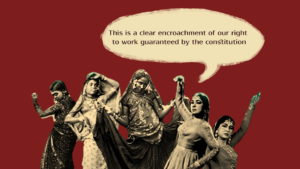
As a child, growing up in a TamBrahm house, I never understood why our domestic worker only entered through the back door, or why she never drank her tea from the ceramic cups and mugs we used but only in steel tumblers that her lips never touched. I only remember this separation was so ingrained that once, even in my half-sleep state, when I saw our domestic worker using the cordless phone instead of the static landline, I shouted out in anger, that ironically, my then-conservative mother mitigated. As much as I cringe at this memory of my academically educated but socially illiterate and inept being, I also never allow myself to forget or erase it. The memory remains an open wound on my skin, bleeding into the dark room of my mind, making the invisible visible again. When I watched Paromita Vohra’s layered documentary, ‘Working Girls’ it felt like a breath released. I never knew my lips too never touched the unsaid till I heard it in someone else’s voice.
Ten years ago, when I interviewed Vohra for her vibrant and sassy ‘Agents of Ishq’ for Arts Illustrated (April-May issue, Volume 3), we talked about her other documentary film, ‘Unlimited Girls’ that, more than two decades on, continues to remain the quintessential film shaping feminist narratives in India. She said then, ‘When I made Unlimited Girls, people were like, “What is this thing? What is this object you have made?” It was a film about feminism that had a little bit of fiction and there had never been that kind of popular culture quality to a documentary in India. It was simply an effort to do what I liked, because I was young and I wanted to see that kind of stuff and to speak in the language of the people around you so that they can enter the space.’ It was a film that I watched as a student, when chat boxes, used as a narrative framework in the film, were very much part of my everyday language.
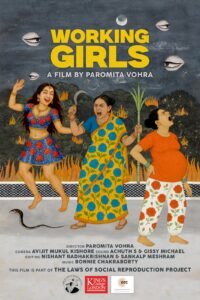
‘Working Girls’, too, is no exception when it comes to speaking today’s language with witty lines (‘How do you solve a problem like Gonorrohea’), relatable symbols (chasma of morality), illustrations and speech bubbles (‘boys will be boys but girls must be poise’), fonts, catchy tunes and hashtags like the ‘reels’ culture we are so accustomed to now, that when I watched the film with my former students, they came out saying, ‘But this did not feel like a documentary at all!’
‘Many people say this use of interactive media makes the film accessible to people. I am not looking for accessibility; it is contemporaneity that I am looking for. When you look at history you see patterns emerge at certain times and are still playing out in the current world. So to use contemporary language is to say that it is not in some museum, or in the past, but in the reality we are a part of right now,’ said Vohra over a phone interview in between her tour of the film. I caught her a few minutes before she boarded the flight, but that did not deter either of us – creator and viewer – from delving into the world of the film that through its ordinariness catapults us into a transcendental world that effortlessly breaches divides. ‘In fact, some of these illustrated sequences that look so simple on screen were the hardest to curate and went through some 15-16 drafts of script.’
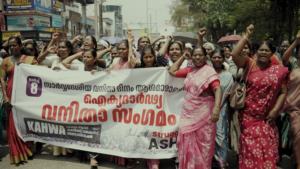
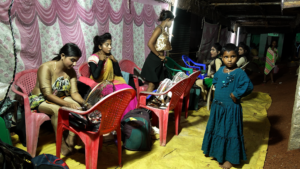
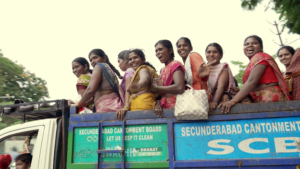
For ‘Working Girls’, Vohra worked in collaboration with ‘The Laws of Social Reproduction’ project conceived by Prabha Kotiswaran, professor of law, and hosted by the Dickson Poon School of Law, King’s College London. The project looks at ‘female reproductive labour, including unpaid domestic work as well as abject forms of labour performed by women outside of the institution of marriage and for the market, namely, sex work, erotic dancing, surrogacy, egg donation, and paid domestic work’. The film, too, looks at these invisible spaces through the lives of women, and extends the narrative into the lives of ASHA workers in the country, while taking us on a journey through 18th Century British India, to the nationalist and independence movements, and to a new, globalised and economically liberalised India.
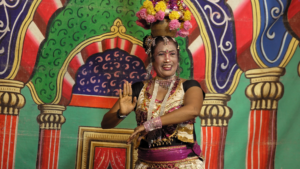
What stands out, however, are simply the lives of the women we follow – P Kausalya Devi in Madurai, an Aadal Padal dancer; Vanita Mane in Pune, sex worker and coordinator of Saheli Sangh, the national network of sex workers; Bishakha Lashkar in Kolkata, secretary at Durbar Mahila Samanwaya Committee for AIDS awareness among sex workers; Rita Ghosh in Mumbai, egg donor and now agent; Urvasha and Sunanda, farmers and housewives in village Takli, Latur; Kamaksha, ASHA worker; to women at protests in Kerala for ASHA workers and protests in Hyderabad for domestic workers; Marina and Evangeline in Shillong, both working for different unions set up for domestic workers; Kumari in Pune, a transwoman and former sex worker now running a brothel; lawyers and historians, and Vohra herself as the narrator, building a comprehensive picture of lives lived through the turmoil of law and rights enmeshed in attitudes and prejudices of dominant narratives. ‘If you see the film you will see that it is just spending time spent with women doing different kinds of work,’ Vohra said in an interview for Frontline, The Hindu. ‘It is not for us to give meaning to someone else’s reality… It is important to listen to different perspectives.’
In the film we see this play out simply by listening to the women and watching them as they go through their day. There is an everydayness that captivates you. Cooking a meal, drawing a kolam, praying to the gods, combing one’s hair, placing the dot of the sindoor at the centre parting, wearing a watch, picking up a pair of chappals and wearing it in the lift, sitting in the train, singing at a protest, worrying about mosquitoes, drinking tea, a fish eaten to the bone, a meal in the farm, stitching, walking, laughing, conversing – it overwhelms you, this ordinariness, the life that thrives through the history of the laws that Vohra is quick to find humour in – SITA (Suppression of Immoral Traffic Act), PITA (Prevention of Immoral Traffic Act), NARI (National ART Registry of India) and ASHA (Accredited Social Health Activist). ‘’Laws are made by people and people come with their own baggage, biases and lack of understanding. History of law, so often, is the history of morality,’ she added.
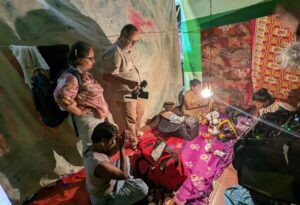
When Bishaka says, ‘This is a fight for our rights’, and it becomes a sort of call to action in the film, echoed through the night of a car simply driving through the rain, the wipers periodically clearing the windscreen, it becomes a powerful reimagining of a sentence burdened by time and dressed up as a cliché. ‘The idea of rights has to be re-infused with meaning. These words have been rendered meaningless; not overused, but misplaced use, or unpoetic use, so to re-infuse the poetry of these things was important to me. When Bishaka says it after she has delivered the thundering piece that “you have a problem if we charge money for sex, but it is okay that you marry a woman and bring her like a migrant labour to your home”, the line “this is a fight for our rights” becomes a stunning revelation,’ said Vohra. With clever use of music and metaphor, Vohra creates a film that is full of feeling asking you to truly see the invisible because ‘seeing it will change the picture you have of the world and your place in it’. ‘The thing is, social reality is complex and all the aesthetic elements we use is to really showcase what is underneath the surface, the reality that is unspoken, which is sensed,’ she said.
With a little over two hours, the film was long but not tiring. It kept us riveted because it asked us to listen, to invite, to dialogue and to step out of the “main character syndrome” this social media culture afflicts us with. ‘Many people say that attention spans are only for the first 90 seconds today, but for so many young people to watch the 135-minute documentary and stay back for a discussion post screening, which is what has been happening in every city of this tour, it tells you something about what a film can do.’
Share