


Where the Real Ends and the Story Begins
Words and reflections with artist Suraj Kumar Kashi on storytelling, surrealism, and the power of seeing.
P Abigail Sadhana Rao
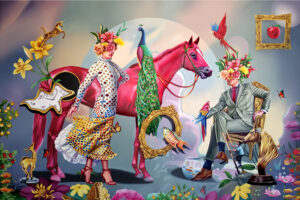
In this fast-paced world, we are constantly in pursuit of dreams, happiness, and fleeting moments of nirvana. Yet, happiness often becomes a moving goalpost and the more we chase it, the more confined we become by the very idea of it. In our urgency to grasp life, we fail to see visceral truthsthose hidden and tucked away in the folds of the mundane.
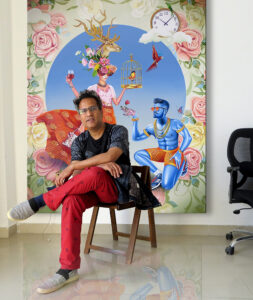
Within an ordinary life, meaning stirs and a story paints its way. A voice like that of Suraj Kumar Kashi emerges—not loud or forceful, but one of deep awakening. Speaking with him felt like perceiving the world in a different way—one shaped by surrealism, memory, emotion, and the radical power of observation. His canvases do not merely depict, they question, they reflect, and they provoke.
Drawing from the surreal, his storytelling takes on a visual form that invites us to pause, to feel, and to reflect. He reminds us that stories are everywhere. They are relics of human experiences, vessels of perspectives, and mirrors of transformation. What matters is who tells a story, and how.
Through the medium of his work, he brings coherence to chaos. He invites us to look again, not just at the canvas, but at ourselves. His journey from a town to a city, reshaped his worldview, particularly in how he witnessed women’s agency in urban spaces, and this evolution pulses through his artworks. In the passages that follow, the conversation with Khasi is not just an interview; it is an unfolding of the process, the philosophy, and the perception. It offers a rare glimpse into a mind that doesn’t chase meaning, but creates it—frame by frame, story by story.
Excerpts from the interview:
Known for surreal, story-rich compositions, what guides the narrative of your paintings?
When I start painting, I begin by thinking about the concept, composition, and the story I want to tell. It is never fully formed at the beginning, but is always evolving. The canvas begins with the “big picture”. I sketch the initial concept first and then incorporate related elements. As I am painting, details that come to me intuitively seem like a storyteller adding subplots, which include smaller elements such as symbols, colours, and movements. Each detail that emerges expands the narrative. I want my art to be layered. You can look once and get a feeling. But if you look twice, maybe you will find a story.
Your work blends lived experience and surreal symbolism. How has your personal journey and cultural context shaped this visual language? Why does surrealism feel like the natural mode for telling your stories?
My journey from Jaumi (a small town in Bihar) to Delhi transformed the way I see the world, and it continues to shape everything I paint. The lifestyle, the mind-set, even the way people interact in my new dwelling, was all unfamiliar and fascinating. This cultural contrast between the two locations became the foundation of my storytelling. My art often explores urban life, not just how it looks but, how it alters people, especially women. I saw women in metro cities with confidence, freedom, and a presence I hadn’t encountered before. While I don’t focus on gender directly, women feature prominently in my work, for their evolving strength and the aesthetic charge they bring.
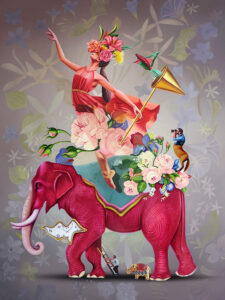
In earlier times, women were confined to their homes, and labelled “ghar ki Lakshmi” and carriers of family honour. Today, they are self-aware and independent. That transition—the rebirth of feminine identity—is profoundly inspiring, and surrealism is the language through which I express this sense of empowerment. A woman may not fly in real life, but in my paintings, she does. I depict her stepping out of frames, dancing on elephants, and blooming into wings, as visual metaphors for hope and liberation. I often paint faces like flowers. That gentle bloom speaks of beauty, strength, and positivity. Even in metropolitan settings, people may be far from nature, but they still long for it and experience it; hence I weave nature, birds, trees, and animals into my work.
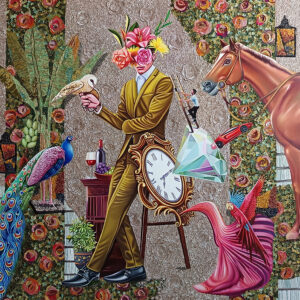
Rather than copying tradition, I create symbolism by reimagining it through the lens of a lived experience. Symbols like open cages, deer, trees, and birds appear repeatedly in my work. Both open and closed cages represent personal liberation; we are our own captors, but we also hold the key. Clocks are another recurring motif inspired by Dali, symbolising the weight and fluidity of time. My concepts are not mere observations of the now, they span generations.
Surrealism is not foreign to India. Lord Ganesha—half-man, half-elephant—is surrealism at our doorstep. It is in our mythology and folktales. I don’t escape into surrealism. I use it to understand the world I’ve come from, and the one I now live in.
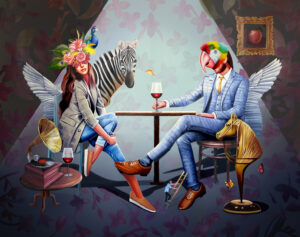
Can you walk us through the story behind one of your most recent paintings—the one featured as the cover art? What were you seeing, thinking, or feeling while creating it?
My earlier works were more vibrant and loud, reflecting the vibrancy of metropolitan life and the evolving identity of women in that space. But my style has evolved with time. Now, I find myself drawn to muted earth tones. They speak of hills and forests, dryness and growth, stillness and movement.
This painting is one of my most recent works, and it features two women living in a concrete jungle (metropolitan space), yet I show them immersed in nature’s spirit. Their relationship with one another mirrors the kind of relationship they share with the natural world—quiet, grounded, and vital. It represents a meditation on how nature and human connection can coexist within an urban chaos. In the background, you’ll notice rock textures that are muted, raw, and earthy. That’s deliberate! The entire composition draws from a sense of organic nature. The two women are clearly from a metropolitan space as you can see their designer clothes and urban poise, but the palette is subtle and soft.
This work came from an experience I had during a visit to the hills and forest. I was struck not just by the animals, but by the textures of the leaves, moss, and rocks. They weren’t glamorous, but they were alive. When I came back to the city, I carried that sensory experience with me. That contrast between raw nature and sleek urban life is depicted in this painting.
Even the medium matters. Acrylic gives me freedom. Oil gives me depth. Together, they let me build something that lives longer, both on the wall and in memory. For me, the choice of medium across my works plays a huge part in building the narrative as it helps carry the weight of the concept. This painting, like many others, marks a point in my journey—an evolution in how I see, and how I invite the viewer to see with me.
Apart from your paintings, your installations carry strong social commentary. What inspired those works?
My installations are an extension of my visual storytelling, rooted in social observation. They are a form of interactive art that is meant not just to be seen, but to provoke thought and action. One of my installations featured bricks painted as books with ornate covers—a visual paradox highlighting how those who sell books or make bricks often remain uneducated. It was about transforming symbols of labour and neglect into tools of learning. I used the money earned from that installation to buy real books for under-privileged children. Another installation depicted a large golden coin made of fibrous material. The concept behind that was the fact that people often ignore open manholes, which can be fatal for children, but tend to always notice a coin on the ground. It has a deep meaning and questions what we choose to see and what we easily disregard.
You’ve worked in both advertising and fine art. How do the stories you tell shift between those two worlds, and what do you want your audience to take away from your work?
When I worked as an art director in an advertising agency, the goal was clear: sell the product. Everything was crafted with that purpose in mind, often exaggerated and sometimes dishonest. I never felt fulfilled doing that work. On the contrary, art carries truth. What I paint comes from my own experiences, dilemmas, and reflections. The intention is not to sell but to share something honest, something that touches the soul. It invites awareness, not persuasion.
Unlike advertising, where meaning is dictated, art leaves space for interpretation. Viewers can find their own meaning in what they see. They may notice things I didn’t consciously intend, and that’s the beauty of it. I often tell people that each piece holds many stories, some even unknown to me, while I was creating it.
As an artist, I offer my truth, but I also value the viewer’s agency. Their experience completes the work. Just as I need freedom to express, they need freedom to feel. And that dialogue, unspoken yet deeply felt, is what gives art its power.
There is no end to stories, and how they are interpreted nor how they are felt. It is limitless.
Share