


A Pilgrimage of Stillness
In the quiet accumulation of time and reflection, creation finds its voice. What settles is not forgotten but transformed, unveiling beauty shaped by patience and faith. In this stillness, T. Nageswara Rao reminds us that art endures in the silent perseverance of becoming.
P Abigail Sadhana Rao
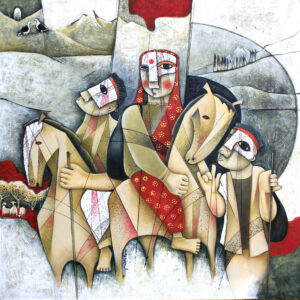
Like ancient sediments resting at the bottom of a river, gathering fragments of memory, time, and transformation, T. Nageswara Rao’s creative journey unfolds in layers, slow, deliberate, and quietly powerful. His life and art are not driven by haste or spectacle but by the deep, rhythmic patience of becoming. Each experience, each brushstroke, each act of perseverance has settled into his practice like grains of silt forming a landscape, textured, enduring, and full of unseen life. In him, the idea of sediment finds poetic resonance, showing that what settles does not stagnate but matures, ferments, and eventually blooms into revelation.
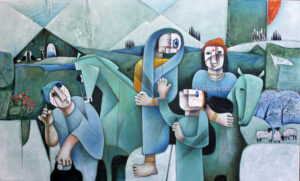
Over the decades, his work has evolved into a meditation on faith, form, and the subtle dialogues between the inner and outer worlds. The act of painting, for him, is not a performance but a pilgrimage, tracing his own spiritual topography. This sensibility reaches its profound culmination in his series The Journey, inspired by his pilgrimage to Amarnath. Here, the Himalayas transcend geography to become symbols of spiritual vastness and surrender, majestic, raw, and timeless.
In his canvases, stillness breathes and silence becomes sound. The mountains speak in the language of color and texture, translating the immensity of nature into moments of divine intimacy. His work reminds us that art, like sediment, gathers strength in the quiet, that beauty often forms not in the rush of creation but in its patient settling. It stands as both an artistic and spiritual testament, a harmonious expression of stillness, endurance, and faith crystallized through form.
Excerpts from the interview
- Your relationship with art began at a remarkably young age. What were those first sparks of creativity that shaped your early world?
I was born in a small village in Prakasam District, Andhra Pradesh, in a family with no artistic lineage. My inclination toward art was entirely innate; it was how I understood the world. In my formative years, I was captivated by nature, with its vibrant colors, intricate patterns, fragrant blossoms, and their colors, forms, and fragrances, studying every petal with fascination. The vivid hues of butterflies and insects filled me with wonder. Drawing, painting, or simply creating something with my hands was instinctive. I didn’t think of it as art then; it was my way of thinking, feeling, and communicating. Even with just paper and a few pencils, I found endless inspiration in the world around me. Art was, and still is, my first language.
- You attended art school between the ages of 18 and 21. How did that environment shape your early years as an artist?
My years in art school were profoundly transformative and laid the foundation for my artistic journey. The college provided a nurturing yet disciplined environment where creativity and structure coexisted beautifully. The curriculum combined rigorous studio practice, close mentorship, and deep engagement with art history, seminars, and exhibitions. I soon understood the importance of sketching and spent long hours in life-study sessions and outdoor sketching at railway stations and marketplaces, capturing movement and everyday life. Exposure to traditional mediums such as charcoal, watercolors, egg tempera, the Bengal wash technique, and oils expanded my artistic vocabulary and helped me find my voice.
- After graduating, you spent years experimenting and searching for your style. What was that journey like?
After graduation, I practiced art and worked as a freelancer for a few years, but financial constraints eventually led me to the advertising industry. I served as an Art Director in Hyderabad and later as a Visualiser in Mumbai. Returning to Hyderabad in 1991, I established my own design studio, and after more than twelve years, I finally attained financial stability. It was then that my original passion for art resurfaced, urging me to paint again.
Finding my artistic identity was not easy. It was a deeply personal and often solitary process. I experimented endlessly, drawing inspiration from nature, the streets, and human emotion. At first, I lacked direction and began by painting landscapes, still lifes, and copies of old masters. To reconnect with the art world, I visited galleries, attended exhibitions, and engaged in meaningful discussions with fellow artists.
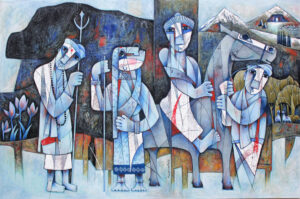
Gradually, I found myself drawn to the ordinary and the unnoticed—the quiet spaces where emotion resides. My art became more introspective, less about beauty and more about truth. I invested in materials, dedicated time to the canvas, and registered with galleries across India. My study of art history deepened, and Cubism, particularly the works of Picasso and M.F. Husain, became a lasting influence on my practice.
- You returned to formal education later in life and completed your Master’s in Painting from JNTU Hyderabad at 48. That’s extraordinary. What led you back to academia after all those years?
I’ve always believed that learning never ends. After returning from Mumbai, I built a successful business and a stable personal life with family, home, and financial security. Yet, despite the comfort, an unfulfilled longing for art persisted, leaving me creatively restless. At 48, returning to academia became essential to honor that lifelong commitment. The experience was both challenging and deeply rewarding, reaffirming that passion does not fade with age but matures with time. It renewed my purpose, sharpened my perspective, and gave me the confidence to once again call myself an artist without hesitation.
- The path to building a career as an artist is rarely linear. What were some of the challenges you faced along the way?
Recognition doesn’t come overnight. There were long stretches where I wondered if anyone would ever see what I was trying to express.The main challenge was balancing the commercial demands of advertising with my inner drive for pure art. Managing time and maintaining artistic integrity while running a design studio demanded immense discipline.
The search for my own voice after graduation was challenging. Moving beyond imitation to develop a distinct style took years of experimentation, persistence, and overcoming self-doubt.
- Your latest series, The Journey, is inspired by your spiritual pilgrimage to Lord Amarnath in the Himalayas. Can you tell us what that experience meant to you?
The pilgrimage to Amarnath was less a physical trip and more a profound spiritual immersion. The Journey series is an attempt to translate the scale, serenity, and raw, elemental power of the Himalayas into visual form. It was an experience that stripped away the superfluous, focusing my attention on fundamental truths. The physical discipline and the overwhelming beauty of the landscape provided a clarity of purpose that deeply influenced my color palette and composition, making the series an intersection of my personal faith and my artistic calling. The Himalayas taught me stillness. They reminded me that even in silence, there is movement, that settling too is a kind of strength. That realization became the heart of The Journey.
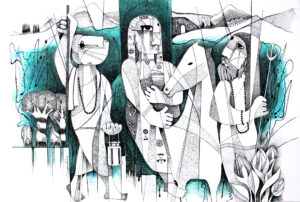
- Your work beautifully merges abstraction and figuration, two distinct visual languages. How did that evolve?
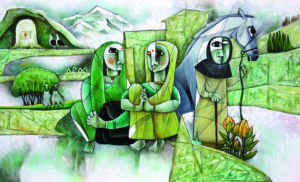
This synthesis evolved organically, primarily rooted in my strong foundation in academic drawing and my subsequent fascination with Cubism. The figurative element ensures a connection to reality, grounding the work in recognizable forms, often human or architectural. The abstraction is where the emotional and conceptual layers reside. It allows me to deconstruct the subject, manipulate space and color, and express the internal experience rather than just the external observation. It’s a dynamic balance, the figure provides the anchor, and the abstraction provides the movement and interpretation. The blend of abstract and figurative felt like the perfect reflection of the inner and outer worlds I was trying to depict.
- When viewers encounter your paintings, what do you hope they take away?
I hope they take away a moment of genuine introspection. I believe art should leave space for silence, for the viewer to enter and discover their own emotion. My work often explores dualities between the material and the spiritual, the structured and the chaotic. If a viewer pauses and feels a resonance, a stirring of personal memory or contemplation prompted by the color or the fractured form, then the painting has succeeded. The ultimate goal is connection, not comprehension.
- Finally, after so many years of creating, learning, and transforming, what does art mean to you now?
Art has ceased to be a hobby or a profession; it is simply my modus vivendi, my essential way of existing. It is the language through which I process the world and communicate my deepest internal truths. After decades of practice and searching, art now represents the essential, non-negotiable core of my identity. It is a continuous journey of discovery, transformation, and ultimate fulfillment.
Share