From the Sidelines
Renowned Malayalam writer Vaikkom Muhammed Basheer relished portraying the sediments of society in his stories, often showcasing the interconnectedness of lives and the layers beneath them.
-Paul Mathew
Sediments—the dregs left behind after the essence has been removed. Or so we assume. We come across great stories about emperors and heroes, warriors and kings, poets and scientists who transformed their world. We also come across the seeming sediments of society—pickpockets, thieves, corrupt politicians and policemen, most of whom we consider as unworthy of literary mention, as people to be ignored. ese sediments were exactly what Vaikkom Muhammed Basheer, the well-known and greatly loved Malayalam writer, wrote about. He wrote about a man who tried to steal a basket of cow dung, and a thief who tried to replace the golden crucifix in the church with a painted wooden one. His logis was “Why does God need gold?”. He also wrote about a pickpocket who declared that his art was an advanced skill certified with a foreign diploma. He wrote about the tea-shop owner, a young girl who cleverly and regularly stole banana bunches from the village market across the river using a shing line and hook, and the local Godman who fascinated devotees with gibberish, and a card sharper who openly admits to being a clever cheat. ese were the people that Basheer wrote about who became interesting not because of what they did, but because of who they were. They were genuine, authentic, passionate. people who romanced and fought, loved, cried and laughed.
Vaikkom Muhammed Basheer himself probably was a sediment. He did not sport the trappings of a famous writer. He wore a simple white kurta and mundu and walked with his umbrella to get his freedom fighter’s pension of 300 rupees every month. If he got tired, he squatted on the roadside watching the traffic go by.
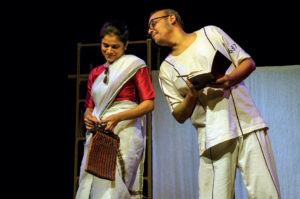
Our theatre collective—PERCH—has done over 70 shows of the Basheer plays across the country. Recently, we did 12 shows at Pondicherry, Chennai and Bangalore. And who were we portraying? e pickpockets, the thieves, the bank clerk who loved a girl from another community, the policeman, the mystic. ere is one scene where a transgender, and a soldier who is still recovering from the trauma of battle, meet and fall in love. When the transgender first appears on stage, there are the typical prejudiced smirks, a few comments and some uncomfortable laughter. Within 30 to 40 seconds, there is absolute stunned silence and the resounding applause as the scene finishes. The audience falls in love with the couple.
This is the power of Basheer. He could look into people and project what was essential and unique. Whether one was an emperor or a thief, there was something within that was universal and authentic. I have had the good fortune of portraying Basheer in all these shows. The play titled ‘Under the Mangosteen Tree’, directed by Rajiv Krishnan, has been very well received. In the most recent series, all 12 house-full shows got standing ovations.


So what was the magic? Simply this. Basheer found miracles in the ordinary. Once they were shooting a documentary film on him and there was a cricket chirping from a tree nearby. It was disturbing the cameraman, and he said, “ is sound is disturbing me. Let me go and get rid of that cricket.” Basheer stopped him, “If you harm that cricket, I’ll break your legs. e cricket has a right to be here just as you do.” Such was his sense of connectedness with the essence of everything, and this is what probably made his work magical.
Once, we performed the play in front of Basheer’s family—his wife, children, and grandchildren. ere were also many friends who knew him intimately in the audience. How do you perform a character within the framework of an existing personality still fresh in the minds of close relatives and friends? Normally the actor has the freedom to explore and interpret the intricacies of the character, the body language and mannerisms. But here was already a person who is still fresh in everybody’s memory and the challenge was to capture that. It may not be possible to capture every nuance of body language, but I realised that it is possible to imbibe and project the attitude, the spirit.
In the initial series, I made Basheer rather serious. During a long break after the shows, I remembered his words: “I make them laugh, but they don’t see the tears behind the laughter.” I brought in a certain lightness and laughter to the character which seemed to have hit the right note. Audiences often told us that we laughed, we cried, we found it deeply engaging and moving.
Basheer was an unusual and intriguing mixture of authenticity, merriment, and mysticism. He wrote, “Oh creator of all these multiple universes, I am not able to contain your vastness in my mind. Enlighten me, help me to understand.” He was groping even beyond the universe for insights, for truth, the essence that is the substratum for all. And this is reflected in all his characters.
One thing that helped me portray this extraordinary, unassuming visionary, besides the director and the brilliant cast and crew, was a documentary film by MA Rahman—‘Basheer: The Man’. I watched it over a hundred times to understand the character and used a few of his conspicuous mannerisms to help align the actor with the character. Fortunately, I didn’t have to work on my hairstyle. Basheer was bald and so am I. I had to shave o my beard though, and replace it with a Bhagat Singh moustache. As a freedom fighter himself, Basheer adored Bhagat Singh and shaped his moustache like that of Bhagat Singh.

Portraying Basheer has been the experience of a lifetime—the epitome of a six-decade-long theatre journey. I learned that sediments need not be cast away. Sediments contain the same essence as the main thing, without the frills, often more truthfully. To give a direct example, after my morning exercise routine, I make a concoction by boiling black pepper, turmeric, fenugreek, cumin seeds, and asafoetida in water. is becomes a refreshing drink and cleanses the system. Before drinking it, however, I scoop out a spoonful of the sediment left in the sieve and munch on it with great delight. I find the sediment as tasty and nourishing as the drink.