


Through Arko Datto’s Lens
Drawn to the fractures of contemporary life, photographer Arko Datto crafts unsettling visual worlds that question what we see—and what we choose to ignore…
– Jenitha Jeyarani S
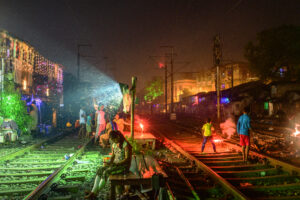
From the abstract depths of theoretical physics to the raw urgencies of climate displacement and digital disruption, Arko Datto’s journey into photography resists linear logic. A native of Kolkata, he fuses analytical rigour with emotional nuance, building long-term visual projects that stretch across both geographic and conceptual borders. Whether capturing the spectral stillness of night in the Bengal Delta or confronting the silent codes of techno-authoritarianism, Datto’s imagery unsettles, provokes and expands the boundaries between documentary and metaphor.
In this Photo Q & A, he reflects on his evolving philosophy, the architecture of his visual narratives and how photography, for him, remains a field of inquiry as much as expression.
Excerpts from the Interview You began your career in theoretical sciences before transitioning to photography. What sparked that shift, and do elements of scientific inquiry still inform the way you build your visual work?
I felt my work in theoretical physics and pure mathematics was too removed from social realities. Over time, I found myself thinking more about art and photography, and that signalled the need to shift paths. Today, I build my projects with a scientific mind-set—each series is its own conceptual universe, governed by unique visual and narrative ‘laws’, much like a mathematical theory built on specific axioms.
Your work weaves together stories from seemingly unrelated realms—techno-fascism, climate displacement or animal captivity. What connects these diverse narratives for you on a deeper, existential level?
At their core, these stories reflect our shared humanity—the struggles, anxieties and hopes of our times. By examining different crises, I aim to explore the emotional and existential undercurrents of the contemporary moment. It’s a way of understanding where we come from, and where we might be headed.

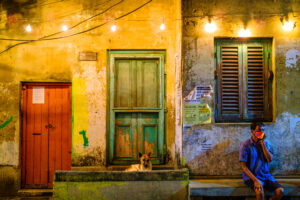
Your long-term project, The Shunyo Raja Monographies, focuses on the Bengal Delta as a ground zero of climate change. What compelled you to take on such a vast, layered subject, and why did you choose to develop it as a trilogy?
Being from Kolkata, I’ve witnessed first-hand how the Bengal Delta is vulnerable to rising seas and climate change. I started by documenting West Bengal, eventually expanding into Bangladesh. The trilogy unfolded naturally—each chapter led to the next, offering distinct conceptual and visual readings of the same fragile terrain. I was inspired by world cinema’s use of trilogies to examine broad themes through multiple lenses. This format allows for richer understanding and reflection.
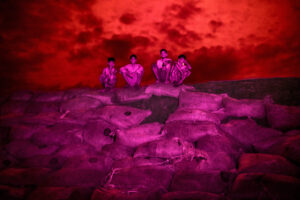
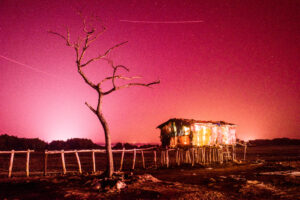
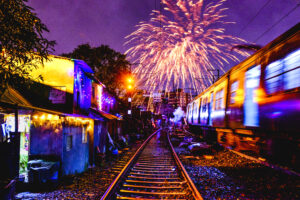
Your use of colour, especially in your night photography, is distinct and often unexpected. What role does colour play in your visual language?
Colour is central to my long-term projects. Each series evolves its own palette over months—even years—of experimentation. Since I approach projects as forms of world-building, the chosen colour scheme becomes a key to expressing that world’s emotional tone and inner life.
The digital age has transformed both, how we tell stories and how we consume images. How do you see your role as an image-maker today, in this hyper-visual, fast-moving media landscape?
The digital era lowered many traditional barriers, enabling a global generation of image-makers. But now we face fresh challenges, especially with AI (Artificial Intelligence) disrupting the visual industry. Independent publications are vanishing, and exhibition spaces are shrinking. Amid all this, I believe it’s essential to keep creating work that is both critically engaged and technologically adaptive—stories that confront the dilemmas of our time.
Do you see yourself more as a documentarian or a storyteller, or perhaps a blend of both? How do you navigate truth, imagination and metaphor in your visual narratives?
In commissioned work, I follow journalistic ethics. But my personal projects are more layered—combining truth, metaphor, surrealism and allegory. Each one has a different mix. I try to innovate visually and conceptually with every project. I don’t chase a singular style; in fact, I often try to avoid repeating myself.
How do you know when a visual narrative is complete? Or are your stories always in a state of evolution?
I consider a project complete when no new insights can be added. Having said that, I still let time pass before making that decision. Often, a project evolves when adapted into a different medium. For example, PIK-NIK shifted from a cultural study to a political one after I added sound and video. Climate projects like Shunyo Raja may never truly be complete, as the crisis itself keeps unfolding.
Beyond your own projects, you’ve curated for major platforms like Kochi and Chennai Photo Biennales. What do you enjoy about curating, and how does it inform your own creative work?
Curating lets me engage deeply with other artists and their ideas. It’s a collaborative process that reveals new ways of thinking, presenting and understanding work. These exchanges often spark fresh directions in my own practice.
You’ve described your artistic aim as pushing the boundaries of still and moving images. What are some new directions or experiments you’re currently exploring?
Right now, I’m working on video and film projects that play with narrative structure. I’m also creating videos using only still images. I often work with degraded or low-resolution imagery—what Hito Steyerl calls ‘poor images’. These visuals, abstracted through their limitations, open up new aesthetic possibilities.
Lastly, what does artistic success look like for you—not in terms of accolades, but in terms of the process or impact?
For me, success is when someone says my work inspired them to pick up photography—or that it changed how they see the world. Art should unsettle, awaken and reorient perception. When that happens, I feel I have succeeded.
Share