


If a Picture Speaks a Thousand Words
A look at how narrative artists have shaped how we tell and interpret stories through a historical and contemporary lens of cultural and art history.
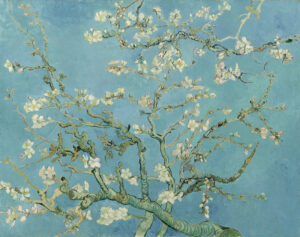
Walking through the Van Gogh Museum in Amsterdam – three glorious floors dedicated to the artist – is like walking through a story. It unfolds slowly, like an opera, stringing together a melody that ripples through you, inexorably pushing you deeper and deeper into the narrative arc. You see Van Gogh’s inevitable madness in his wild brushstrokes, his tenderness in the Blossoming Almond Tree, his love in his letters to his brother, his desperation mirrored in the faces he saw around him, and the over-arching theme of beauty in the world around him. Snatches of what he said are peppered around the walls of the museum denoting echoes of a voice that refuse to die. Even if all you know about Van Gogh is the Starry Night (ironically, that painting does not rest here) the museum offers a real window into the life of an artist who was deeply troubled and relentlessly inspired. In other words, it tells a good story.
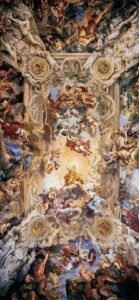
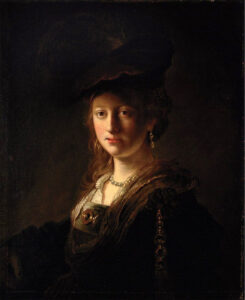
One of the fundamentals of any art form is to be able to do that. To invoke in us a feeling that breathes narrative form and structure and leaves us wanting more. To raise endless possibilities where the story can be continuously redefined, reimagined and retold. While a lot of traditional artists and masters revelled in this – Rembrandt could tell a story simply with the play of light and shadow, Michelangelo strapped himself upside down to paint nine scenes from Genesis on the ceiling of the Sistine Chapel, Leonardo da Vinci gave us a very animated The Last Supper, and Claude Monet gave us a meditative expanse of lilies to ponder over… and yet, the post-modernist world of contemporary art became more and more insular. From allegorical and mythological stories, from nature’s exhaustible stores of feeling, from the definitive movement of Narrative Art that spanned from early cave paintings to the 20th\ century, story-telling is at the heart of a brush stroke.
‘Whatever may be said of the art world, it is not rotten. Painting is a faith, not created by the hands alone but by something which wells up from a deeper source in our souls…’ –Van Gogh
In an increasingly polarised world full of social detachment and individual obsession, art is no more faith. Time is not ‘art’ but ‘money’ as Arthur C. Danto says eloquently in his collection of essays, ‘The Wake of Art’. His famous phrase ‘end of art’ looked at the changing face of art as we know it. ‘I used “end” in a narrative sense, and meant to declare the end of a certain story’, he says in the essay titled ‘Art After the End of Art’. ‘My thought was that art came to an end when it achieved a philosophical sense of its own identity and that meant that an epic quest, beginning sometime in the latter part of the 19th century, had achieved closure.’ It marked the beginning of cinema or ‘moving pictures’ that ‘left painting behind’. He also argues that commercialisation of art, the business of art as exemplified by Andy Warhol, also meant a destruction of the faith that Van Gogh talked about.
‘It is not what the artist does that counts, but what he is’.– Pablo Picasso.
Where does narrative art sit in the contemporary world? Or rather, where do stories persist? Danto warns of art becoming something that is merely consumed, and not something that ‘immortalise(s) the mortal’. William Blake in 1820 predicted, ‘Where any view of money exists, art cannot be carried on’. Seventy years later Ganguin wrote, ‘A terrible epoch is brewing in Europe for the coming generation: the kingdom of gold. Everything is putrefied, even men, even the arts’. I wonder what they would say about the world today. As we live in the crisis-of-stories era – even my breakfast becomes a story – the time and space for reflection, for quietness, is dissolved in the clamour of everyone becoming a story-teller. To live, to be human, is to tell stories, of course, but it needs a sense of immortality. In the self-portraits of Firda Kahlo and Vincent Van Gogh , there is the sense of otherness that allows us – the viewer/reader – to inhabit that space. In that particular expression or moment (Van Gogh even painted a self-portrait with his bandaged ear), a universal agency is given to us. We can become them, because they are already altered. In the persistence of time and day, their stories, however transient, become solid. In the selfie-culture of ‘stories’, the solidity of life becomes ephemeral. There is no need to commit anything to memory, or to embark on journeys of self-hood, the erasing and rebuilding of it based on memory’s elusive quality. Life becomes performative, a mortality that dies into its own sense of urgency. ‘Today’s postart seduces us to death not life’, said Danto.
‘When machines have come, art has fled’– Paul Gauguin
To be an artist today, among the threat of AI (Artificial Intelligence) looming large, the role of art and stories is incumbent to the sense of self. At the risk of sounding like a disgruntled curmudgeon lamenting the loss of the analogue way of life, there is a need to reassess and realign this faith, this ‘deeper source’ of what makes a story, a story. ‘Who believes in the aesthetic contemplation when there is no time to contemplate and time is money? And what is sensuousness in a world of simulation and reason in a world of computers?’ asked Danto in 1996. Almost 30 years later, we still don’t know.
While walking through museums in Europe, where the Western masters of art reside, and watching people swarming around famous masterpieces with phones and poses to then post on their Instagram stories, it made me wonder how far away from contemplation we are and how precariously close to disruption. But if stories have taught us anything it is that they existed even before words did, and they will continue to morph and transfigure in deliciously playful and astute ways. It is up to us to keep pace, and in Van Gogh’s spirit, keep the faith.
Share