The Quiet Theatre of Everyday Architecture
Blurb: In India’s older neighbourhoods, architecture isn’t just built – it’s lived. Rather than being mere spaces, they become the habitual stage for the ordinary.
– Vani Sriranganayaki
Some homes are built to impress; others, simply to hold space. But then there’s a rarer kind – the ones tucked into older neighbourhoods, far from the pages of glossy coffee table books – that pull off something quietly radical. They don’t just shelter you; they mirror you. Or more precisely, they mirror the ‘you’ that belongs to the place – shaped by its pace, its quirks, its weather, the gossip of its streets. They are homes that grow into themselves – and into you – through habit, history, and the daily theatre of local life.
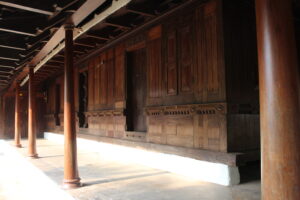
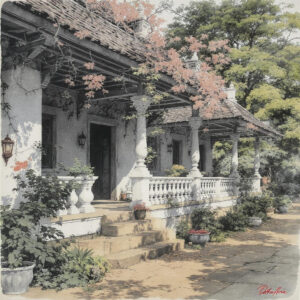
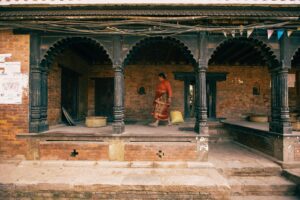
Step into such a house and you’re rarely ushered straight into a living room. More often, you’ll find yourself on a Verandah (a Thinnai in Tamil Nadu, a Poomukham in Kerala, Otla in Gujarat, Balcão in Goa…it goes by many names) Shaded, slightly raised, its tiles or weather-worn cement floors carry the soft polish of decades of footsteps and seasons. It’s the pause between the street and the sanctum, where guests are welcomed, tea gets served, and dusk gathers over shared stories. It may not announce itself with grandeur, but it hums with purpose.
Pritzker laureate Ar. B.V. Doshi once called Architecture ‘a living entity – an extension of life’ something that belongs to the place, the time, and its people; and ‘connects us to memory’ In much of India, the Verandah is exactly that. A space both of display and discretion, it holds the spillover of domestic life: a grandmother shelling pea, children busy with their games, a passing neighbour stopping for a quick chat. Verandahs are no architectural accident. They are deliberate responses to geography, climate, and culture. In humid coastal regions, they coax in cross-breezes; in more conservative settings, they keep the public at a polite distance. Above all, they adapt – to season, to social custom, to the evolving rhythms of the household.
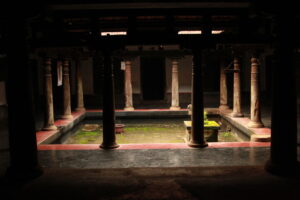
Next, the open courtyards common to old family homes. A few decades ago, these sky-lit, spaces were central to the household – where red chilli was dried, mangoes were pickled, children were bathed under the sun, and where the family gathered for any event or occasion (including power cuts). Then there’s the Aangan, the informal backyard often doubling as a kitchen garden, alive with Tulsi plants, curry leaves, and the occasional well. The back steps here are as much a stage for idle conversation as they are for household chores. Inside, alcoves carved into thick lime-plastered walls hold more than knick-knacks – they hold memory. A particular shelf might always have the radio, another might house spare spectacles or a collection of books, passed from one generation to the next.
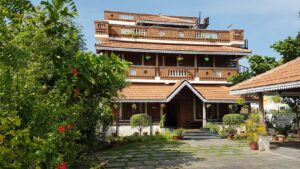
RL Kumar of Centre for Vernacular Architecture once described these spaces as ‘the lungs of a home.’ He once taught me that these spaces were not just about light or ventilation, but about life unfolding in its most elemental form – eating, cleaning, resting, caring. These aren’t grand architectural statements; they’re spatial stories shaped as much by ritual and routine as by bricks and mortar. None of these spaces are intentionally decorative. They are however the architecture of intent; of quiet intelligence written into walls, thresholds, and platforms, making them less a design trend and more a lived, breathing habit.
But the contemporary story is a little different. The features that once quietly shaped our lives are now either polished into aesthetic props or erased entirely. Courtyards morph into atriums. Verandahs become ‘security risks.’ Thresholds become ‘inconvenient.’ In the process, the choreography of daily life gets flattened into floor plans designed to sell, not to serve. In his book ‘Letters to a Young Architect,’ late Ar. Christopher Charles Benninger called this ‘façade architecture – the packaging of buildings in trendy wrappings.’
It’s no coincidence that many ‘climate-resilient’ designs today turn to the vernacular. Lime plaster, rat-trap brick, Jaali windows, rainwater channels – local building traditions refined over centuries are still the most intuitive, sustainable responses to climate. But they also do something less measurable: they anchor architecture within a forgotten memory.
While giving a tour of his home, many years ago, Ar. Venkat Aiyadurai of Natraj & Venkat Architects spoke of designing homes that ‘age gracefully.’ He wasn’t talking about longevity of materials, but about habit. ‘Does it let the grandmother sun herself away from curious eyes? Can a child run barefoot without getting hurt? Will guests instinctively know where to leave their slippers?’ These aren’t design-school metrics – but they’re deeply architectural questions that root a house to its place and people.
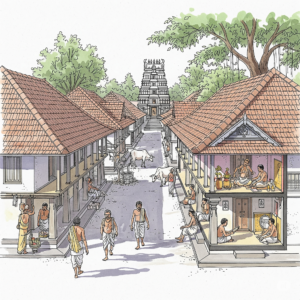
The irony? We often notice such details only when they’re gone. Modernisation and real estate pressure chip away at the spatial generosity of older homes. And slowly, homes stop just looking the same – they start living the same. Which is why the question of ‘local’ matters – not as nostalgia, but as a challenge. What would it mean to design locally today? Could homes still grow from practice rather than Pinterest boards? One answer lies in the kind of architectural practices emerging from Auroville. Many of the architects there – like Poppo Pingel, Satprem Maïni and Suhasini Ayer Guigan, to name a few – have long embraced the idea of homes not built in isolation but in dialogue with their surroundings. They work with mud, stone, breeze, and sun. And crucially, they allow the home to evolve.
To write about architecture through the lens of the ‘local’ is not to romanticise old homes. It is to recognise that space is never neutral. Every layout is a value statement, every design choice a declaration. And if we want to preserve the quiet dignity of lived experience – of spaces that let us be – then we must begin by paying attention to where those experiences come from. And perhaps, if we’re wise, they can hold clues to how we might live again.