


Walk on the Wild Side
Cartoon Saloon’s Wolfwalkers uses hand-drawn animation to transport you to a world where humans find freedom by embracing their animal instinct
Rehana Munir
With Attenborough-voiced nature documentaries scaling new heights of visual glory every year, audiences have exhausted their repertoire of disbelieving gasps and appreciative sighs at the wonders of the physical world. On the other hand, there is the CG-animated juggernaut that astounds with its imaginative powers; from Moana 2 to Mufasa: The Lion King, there’s nothing the digital gods cannot fashion, aided by an army of technicians and storytellers. But at the heart of the entire animation project – the multimillion dollar budgets and thousands of studio hours – lies a little child wandering in the woods. In 2023, Japanese maestro Hayao Miyazaki returned from retirement to give us The Boy and The Heron, very much in the child-in-the-woods domain. His Studio Ghibli has pride-of-place in the hand-drawn, folk-inspired animation canon. Irish studio Cartoon Saloon shares these endearing attributes; and pandemic-era release Wolfwalkers (2020) is an upbeat blend of layered storytelling and inspired animation.
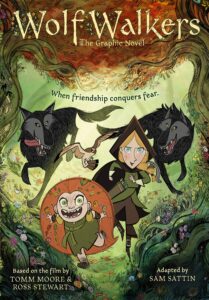
The last of the studio’s Irish folklore trilogy (following The Secret of Kells (2009) and Song of the Sea (2014)), Wolfwalkers is familiar in all the right ways, even if you haven’t watched its predecessors in the series. Centred around a series of dualities (nature vs humans, conformism vs freedom, superstition vs magic), it treads familiar territory for animated films. But the film achieves its particular success through hand-drawn animation that takes you back to leisurely childhood hours rapt in the pages of a hardbound fantasy that your eyes know by heart. The animation is straight out of the vivid imagination of its makers – a loving tribute to childhood stories, and one which reignites all their miracle and wonder.
The story is sprawling in scale and detail. It’s Kilkenny, Ireland (where Cartoon Saloon is based) in the year 1650, when a Cromwell-like Lord Protector is stomping all over his subjects. He has recruited one Bill Goodfellowe – an English hunter – to kill the wolves that run free in the jungle outside the city walls, which he sees as a menace. Bill’s daughter Robyn is an enthusiastic would-be hunter herself, even as she is bullied by the local kids who mock her for being an English outsider. Through a series of misadventures, she meets the wild Mebh in the jungle – someone who describes herself as a wolfwalker; she’s a girl when she’s awake, but a wolf when she’s asleep. The two girls strike up a friendship, which is the soul of the film. A lot more happens. We see Robyn’s struggles with her overprotective father. The plight of the wolves who face the destruction of their forest. The woes of Mebh, whose wolfwalker mother Moll has been captured in her wolf state. The betrayal Mebh feels at the hands of Robyn. And so on.
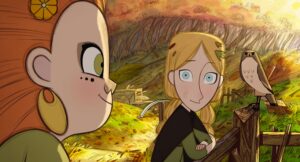
Grand in ambition, the film references historical events like Cromwell’s violent reign and the Salem witch trials, both of which took place in the eventful 1600s. And there’s more than just a subtle allusion to Brexit, too. In fact, the dramatically puritanical nature of the Lord Protector draws parallels with many of today’s rightwing world leaders. A comic book villain that nonetheless triggers all-too-real associations in these afflicted times. It could be argued that the film’s plot runs all around the city and the jungle, as if reiterating its central theme: freedom in the political and primal sense. And this could get a bit distracting. While the senses are occupied by the stunning visuals – enchanted forests, bustling markets, gambolling beasts – the viewer is simultaneously processing profound themes like the hubris of humans, and the meaning of liberty.
As a result, you’re pulled in a few different directions at once. I wanted to root for Robyn, the braveheart migrant relegated to domestic chores, but I soon lost my heart to the wild Mebh, celebrating her hybrid identity while dealing with next-level mummy issues. Then there was poor Bill – an ineffectual hunter and overcautious father, who scores some points when he turns into a wolfwalker himself. And finally, there’s the grievously wounded wolfwalker Moll, who makes a compelling case, embodying the twin forces of motherhood and myth.
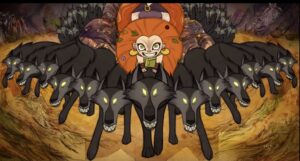
It is in the friendship of Robyn and Mebh that the sprinting narrative finds a moment of calm. The sheer joy of two young girls forging an unlikely friendship in impossible circumstances is contagious. And when you see them break out of their human form, chasing each other in the wild like only two animated wolves can, you feel a surge of pure emotion that the rest of the film somehow lacks. The Running with the Wolves theme song (a new version by the musician Aurora), uses medieval Irish instruments and modulated howling to rousing effect.
In the Anthropocene, creative artists are tasked with spotlighting the burning issue of environmental degradation. Wolfwalkers scores well on that count while managing not to sermonise to its wide demographic. Of the several threads that the film interweaves, the puritan vs pagan one holds together nicely. In the character of the Lord Protector, we see the dangers of a narrow interpretation of religion, leading to what a contemporary critic would term “othering”. The corollary to this is the paganistic acceptance of our wild side – the film closes with the central characters, now a wolfwalking family of choice, trotting merrily away into a safe future.
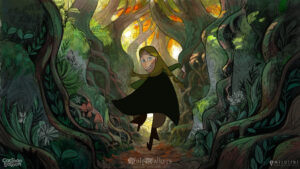
Even while it wears its politics on its sleeve, Wolfwalkers obediently follows the laws of the fantasy/adventure genre, which dictate that fun must be had. And fun, in this case, refers to an immersive journey into a long-ago time and faraway place. The film hinges on an optimism that might not be everybody’s glass of ale, but in this hand-drawn world of breathtaking beauty, you’re up for the ride till the end. Robyn and Mebh safely asleep in a carriage in their human forms, yet bounding away in the great wide open as wolves. Far from the tawdry werewolf trope and lone-wolf type, we have two spirited girls embracing their inner wolves with rapacious delight. That’s enough reason to howl.
Share