


Memory in the Liminal Spaces Between Decay and Life
With time, in the cracks and shadows of abandoned, once thriving spaces, something stirs – moss, roots, and tendrils weave a quiet narrative of rebirth. In the hushed stillness of forgotten memories, nature whispers stories of reclamation
– Vani Sriranganayaki
One of the enduring lessons I carry from architecture school is that human experiences are deeply intertwined with the spaces we inhabit. From the way our mornings unfold based on which side of the bed we rise from, to pasts shaped by schools, playgrounds, or streets, spaces silently weave themselves into the fabric of our lives. They transform, often unnoticed, from houses into homes – anchors for our dreams, memories, and futures. As fleeting as human life may be, it is inextricably linked to spaces meticulously crafted to outlast us. Yet, do they truly endure? e grand
theatre of time is littered with ruins and abandoned spaces that once pulsed with life. With vestiges of structures straining skyward, as if to defy both gravity and time, these are
spaces where now, silence reigns. Human memory fades faster than the stones it shaped, and burdened with a lofty task, those stones leave behind all but ghostly outlines of what once was.
With time, in the cracks and shadows of those abandoned, once thriving spaces, something stirs – moss, roots, and tendrils weave a quiet narrative of rebirth. In the hushed stillness of forgotten
memories, where walls crumble and paths are overgrown, nature whispers stories of reclamation. Here, human memories linger – not as echoes, but as seeds sown in the soil of nature’s vast, unfading memory, reshaped and reborn into a tapestry of green.
These ruins hold an almost magnetic appeal. They are visual markers of humanity’s impermanence and nature’s resilience. Famous examples like Cambodia’s Angkor Wat and Italy’s Pompeii often
dominate narratives of reclamation, but lesser-known places tell equally compelling stories.
Nestled deep in the Namib Desert in Southern Namibia, Kolmanskop once stood as a beacon of prosperity, a thriving diamond mining town in the early 20th century. Grand mansions and opulent
infrastructure bore testament to the wealth and ambition of its fortune-seekers. But as the diamond rush faded, so did Kolmanskop. Slowly but relentlessly, the desert reclaimed its own. Sand dunes now cascade gracefully down once-luxurious staircases, lling abandoned rooms with golden grains, transforming opulence into hauntingly beautiful images. Native desert plants have also
returned, their seeds lying dormant beneath the sands for decades, waiting patiently for the right moment. is quiet resurgence speaks of an ancient memory – a reminder that nature always remembers, even when we try to forget.

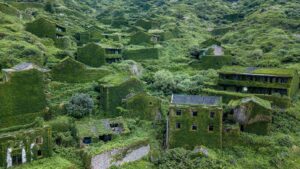
Halfway across the world, in the island village of Houtouwan, just a few clicks east of Shanghai’s ceaseless hum, a di erent landscape tells a similar tale. e story shifts from golden dunes to a sea of emerald vines, yet the essence remains the same. Vines cascade over rooftops, dense greenery swallows crumbling walls, and tendrils creep through empty doorways. Until the 1990s, this was a bustling shing community, alive with human stories and the rhythm of the sea. Now, it stands as a lush, living monument to the passage of time and the persistence of nature.
Houtouwan is a vivid, verdant illustration of how swiftly the wild reclaims its own when humanity steps aside. e once-busy village has transformed into an overgrown labyrinth, a place where nature whispers forgotten tales through the rustle of leaves and the flutter of birds that now call the collapsing roofs home. It is a reminder of the impermanence of human endeavours and the quiet resilience of the earth, forever waiting to embrace what was always hers.

In the Chernobyl Exclusion Zone, nature’s power to reclaim takes on a different form, adapting to a world forever marked by human folly. Once home to tens of thousands of workers at the Chernobyl nuclear power plant, the city of Pripyat was abandoned as a nuclear wasteland following the 1986 disaster. Yet, in the absence of humans, wildlife has not only endured but flourished. Wolves, deer, and even rare endangered species like the Przewalski’s horse now roam freely through the deserted streets and forests.
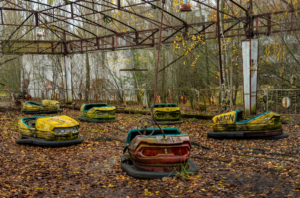
Przewalski’s horse, the last surviving sub-species of wild horse, was declared extinct in the wild by the mid-1950s, with only captive populations remaining. As part of a bold experiment, 36 horses
were released into the Chernobyl Exclusion Zone between 1998 and 2004. Within a decade, their numbers nearly doubled to 65! ese animals seem to have ‘forgotten’ human presence but retain an
instinctual drive for survival, adapting to an environment reshaped by human absence. Wildlife ecologist Jim Beasley’s studies on the aftermaths of both the Chernobyl and Fukushima disasters show similar patterns of natural rebirth, suggesting that human presence, perhaps, posed a greater threat to wildlife than the radiation itself.
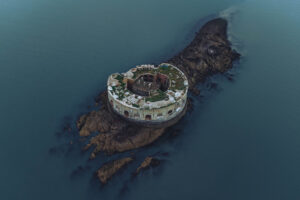
And then, there is the quiet dignity of the Stack Rock Fort which tells a more deliberate story. Perched on a rocky islet o the rugged coast of Wales, the Stack Rock Fort rises like a sentinel
from the sea, its stone walls weathered by salt and time. Built in the 19th century to guard against invasion, it once echoed with the clamour of soldiers and the rhythm of military life. Now, it stands in quiet de ance, its purpose long outlived. Ivy trails down its battlements, wind whistles through empty chambers, and seabirds wheel above, nesting where once guards stood vigil. The relentless tides lap at its foundations, their rhythm as eternal as the stone’s erosion.
Yet, the fort is neither forgotten nor surrendered entirely to decay. Its caretakers, visionaries in their own right, have chosen to preserve it not as a monument frozen in time but as a ‘living ruin’ – a delicate harmony between human history and the wild embrace of nature.
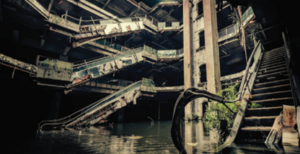
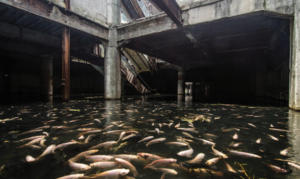
Equally compelling is the story of the New World Department Store in Bangkok, Thailand. Once a bustling, gleaming shopping centre, the store was abandoned when the building’s owners pulled out mid-construction. Over the years, nature has slowly claimed the empty building, lling it with vines that curl around forgotten escalators. Closed in 1997, and gutted by re two years later, the lower floors of the mall quickly lled with water.
Mosquitoes thrived in the stagnant waters and locals introduced Tilapia fish to combat the problem. The fish thrived and the mall is now a giant urban pond – offering a striking contrast
to the vibrant city surrounding it, and a whole new world of possibilities. What makes these reclaimed spaces so captivating is the way nature seems to ‘remember.’ Plants sprout from cracks in concrete, roots break through asphalt, and animals colonise once-bustling human spaces. This interplay of life and decay raises fascinating questions about memory – not just in the human sense, but in living organisms themselves.
Abandoned structures, overtaken by nature, occupy a liminal space – standing on the threshold between human aspirations and nature’s defiance. Here, the past and the present intertwine. They stand as living archives of both what was and what can be. They remind us that even in abandonment, there is renewal, and in ruins, there is life.
Share