


FRAGRANCE – THE MUGHAL GARDENS
Blurb: The gardens of paradise are the places of highest aesthetic enjoyment; so don’t let your mind waver as I take you through a stroll through the verdant magnificence which is the Mughal Gardens
– Shaistha Shabnum
I believe it was during the dynasty of the great Mughals that the art of gardening became a fine art in India. The Mughal sovereign, princes, and the affluent have tried to visualise the image of the promised garden of paradise in the shape of the early gardens, and, coincidentally, Delhi, the capital of India, panned out as their gardening hub.
Gardens stretched out lavishly on three sides of the city, in a straight line, with the western side bordered by a mountain; truly, Delhi is a city of gardens and the most famous gardens, a few of which still exist in changed forms or in ruins, were laid out during the dynasty of Babur, the Prince of Gardeners.
As flourishing and beautiful as the gardens of Mughals were, they followed the tradition of formal gardens in India. Their standard theme revolved around linking vegetation, water and land in an aesthetic and harmonious whole, tracing their origin back to the first of the irrigation systems to be developed. What we simply call a place for residing, enjoying evening refreshments under the cool wind and golden sunsets was constructed with well-thought-out plans for water management and irrigation in the middle of the 17th century when technology wasn’t even a whisper. This cannot be more evident as you stroll across the Baghs or orchards, enclosing the narrow tunnels of water crisscrossing around the lawn. And as I delved deeper into the subject, I noted that the water in the said era had to be brought down the mountains using extraordinary engineering to the arid plains by a complicated canal system.

Taj Mahal, Photo Credit Radosław Botev, 2015, Wikimedia Commons
One of the garden designs making the case in point is the interesting early invention, the Char Bagh – a garden which is divided into four lush plots with a network of grids, interlaced with exotic elements like fancy water fountains built on bases of marble statues along with waterfalls, negotiating large differences in levels falling on to the stone terraces creating a serene sound and appearance. The pleasure garden, as it is fondly called, is built using three themes in a harmonious setting: the flowing water channels, the accessibility of a water source to the garden plot and the use of grid-plotted internal spaces to be used for ceremonies.
The founder of the Mughal Empire, Babur, especially took a liking to the Char Bagh. Among his successors, a few took a liking to constructing and detailing gardens and a few didn’t. But it wasn’t until Shah Jahan, who marked the milestone for Mughal gardening and floral design with his globally famous Taj Mahal and Red Fort containing the Mahtab Bagh.
As we finish reading the science and innovation behind the gardens, we notice that the Baghs are fashioned either square or rectangular, further divided into small parterres planted with fruit trees alongside the flower beds, proving that they were obsessed with symbols and incorporated it in their gardens by coupling trees of various sorts. High walls pierced by imposing gates enclose the green space, with the larger trees stretching over them and defining the main axis of the garden.
Yet, the main attribute as well as a challenge of these gardens remained water. Water played an important role as they required a systematic flow for irrigation and the cooling effects during summer. A large tank called the hauz was built to gather water from the canals, and posh pavilions were placed in the centre of the garden’s pools to serve as a retreat from the sun. What’s more, a large masonry platform was built under a tree where people could sit, rest and enjoy a variety of entertainment. The ethereal shayaris and ghazals which we hunt for on the Internet today were enjoyed at leisure, under the play of light in the olden days, as the emperors embraced sunlight and harnessed it with specifically chosen textures and shapes. Now wouldn’t that have been a sight to see…
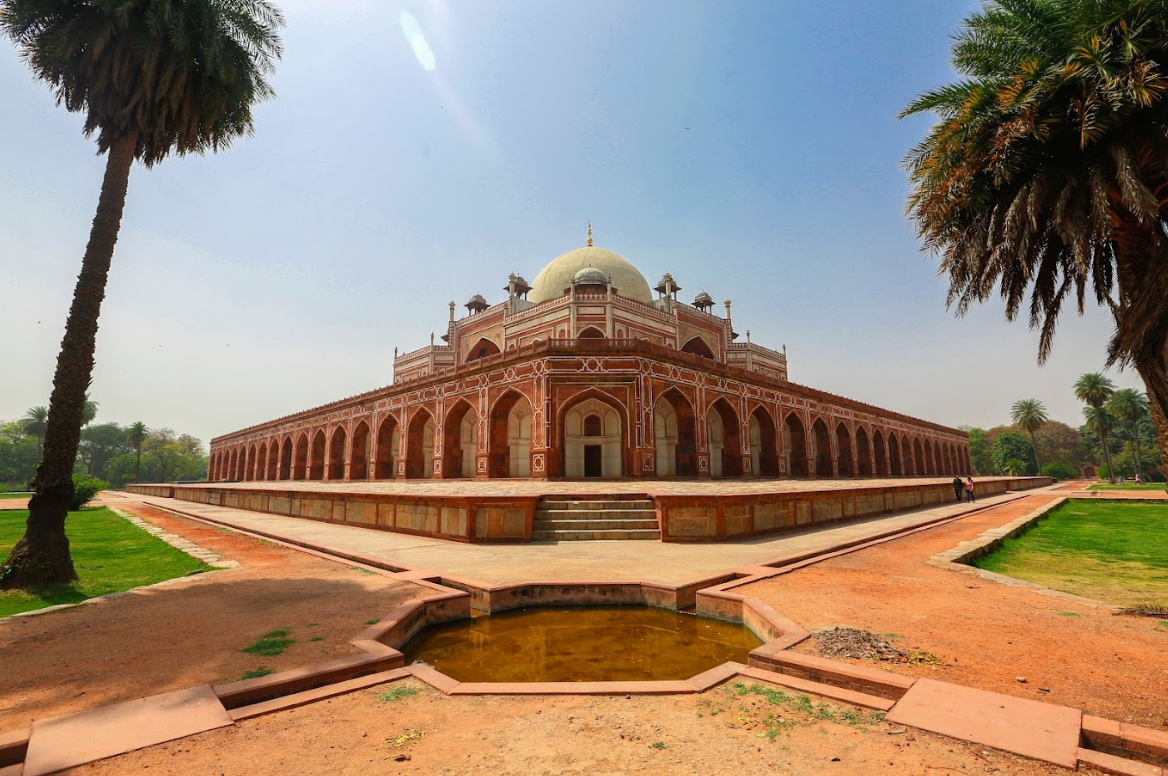
Humayun’s tomb, Photo Credit Udit Kapoor, 2018, Wikimedia Commons
Let’s delve into the pages of history to know the truest nature of this man who built sights for sore eyes…
It was 1526 A.D. when Babur conquered India, and from his autobiography, we know of his love for gardens. Unfortunately, even the greatest of the Mughals faced a drawback in the lack of running water as the goal was to make sure the waters flowed by means of wheels erected wherever they settled down, so that grounds can be laid out in an orderly and symmetrical way. With this object in view, they crossed the Jun-water to look at garden grounds. The beginning was made with a large well from which water comes for the hot baths and also with the piece of ground where the tamarind trees and the octagonal tank are. Next came a large tank with its enclosure and then the ‘talar’ in front of the outer residence, followed by the private house with its garden and various dwellings and, finally, the hot bath. The plots of gardens were laid out in order and symmetry, with suitable borders, partners in corners, border roses and narcissuses in perfect arrangement.
Oh, and did you know that the Agra Garden (now Ram Bagh), built by ours only in 1528 A.D., is said to have been the first Char Bagh? Criss-crossed by paths and waterways, located about five kilometres northeast of the Taj Mahal, water representing life, the garden is stated to be a replica of the Islamic ideal of paradise, an abundant garden through which rivers flow.
In the 16th century, an original idea stroked the Mughals, and they began designing tomb enclosures as gardens. A central mausoleum replaced the pavilion and the Char Bagh layout was formalised into a perfectly symmetrical square plan. Places for prayer, places for the nobility to relax sipping rose-water sherbet and chilled lemon juice, seats on rich carpets and much more were included in this part-religious, part-secular design. Humayun’s Tomb, the first garden tomb in India was planned in the midst of a Char Bagh serenaded with elements like stones, pathways, canals, lily ponds, lotus tanks, stairs, cascades and waterfalls. The garden is divided into a grid of 36 squares with water channels and paths.
As we travel down the lineage, we meet Akbar who was the first Mughal to have entered the Kashmir valley and found the Nasim Bagh at Srinagar, which went on to become the first in a long series of terraced gardens after Babur. It is melancholic when I think about the garden (and the other early gardens) that rose over the Dal Lake, lost all its architectural features. The shrine of Hazrat Bal now stands on the site as a memoir.
Jehangir was, like his grandfather, a passionate gardener. The Shalimar Bagh at Srinagar was an elaborate affair. It is one of the best terrace gardens in the world built by the ruler in 1619 A.D. on an ancient site, at the end of the Dal Lake connected by a broad canal. The Diwan-i-Am (public garden) was situated over the central canal flowing through it, the Diwan-i-Khas (emperor’s garden) in the centre and the Zenana (ladies’ garden), the exquisite part of the project, in an adjacent terrace.
A series of cascades and fountains adorn all sides, but it’s quite impossible to move your eyes from the most impressive part of the Shalimar garden – the central canal, which along with its accessories dominates the garden. The water courses in the Shalimar are so wide that stepping stones and stone bridges had to be built for them.
The Chini khanas or arched niches behind garden waterfalls; the foaming water cascading down the terraces; the fine fountain jets with rose trees bordering the edges of the canal; tall Cypress trees reflecting in the placid water, a dark green reflection; the breathtaking sight of the Chinar trees in autumn and spring… the Shalimar is very poetic, if not romantic.
Speaking of romance, we have Shah Jahan who is famous for erecting an entire monument for his lovely wife. A little known fact about him is that he was a very spirited garden layer.
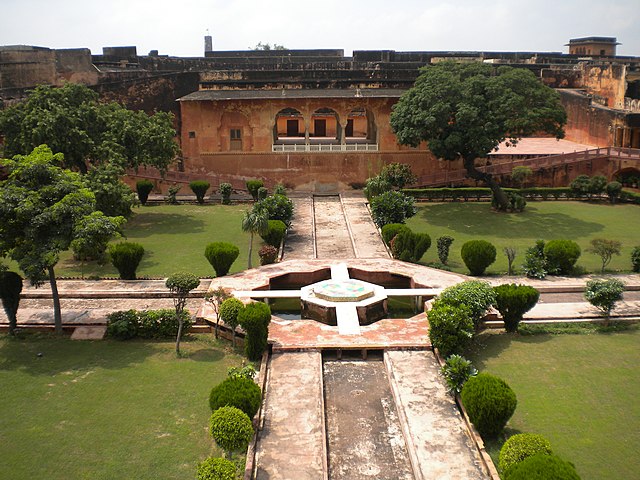
Jaigarh Fort
Shah Jahan was responsible for many novel gardens of the terraced type at Lahore and Delhi. His Shalimar at Lahore boasts of space and splendour than his other gardens. It has a piece of his ancestors’ gardens like the Persian pattern of Char Baghs and terraces, and a canal running through the centre like Jehangir’s Shalimar. His speciality lay in the flower parterres curling into a curved design instead of the straight lines, shaped as octagonal star patterns, and flowers being grown in oblong beds with the cypress trees planted in the octagonal stars. In fact, Taj Mahal’s garden is a wonderful example of a tomb garden. It is an unusual layout where the main tomb is located at the end instead of the centre, pertaining to it as Earth’s paradise.
At present, more than 40 Mughal gardens survive in ranging states of conservation, all having been significantly changed over time. While these gardens may not be as well known to travellers as the Taj Mahal, they are open to the public and represent an extraordinary ensemble of the Mughal heritage, as well as provide recreational spaces in a bustling urban environment. The surviving gardens now face challenges of urban development, pollution, traffic congestion, and lack of visitor amenities. Highways and bridges built close by represent a negative visual impact. And yet… yet, the grandeur, colour and the fragrance of these gardens linger and remain a dominant part of the Indian landscape.
Share