


Sedimented Truths
Embedded deep into the layers of the earth are patterns waiting to be discovered, waiting to be read, and waiting to bring meaning to our inchoate realities.
-Praveena Shivram
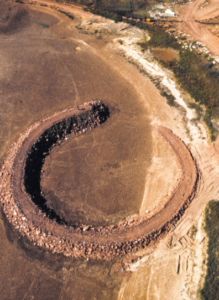
The word ‘sediment’ immediately conjures up science classes in school, with different coloured diagrams to show the sediments that make up the earth’s crust, or a helpful practical demonstration of sediments settling at the bottom of a beaker of water. ‘Sediments’ also brings the weight of time into the mix, where a piece of rock could carry the immeasurable heft of years gone by. Or simply, the ground beneath our feet, that carries the endlessness of a beginning and the infinite possibilities of an ending. It becomes then quite a fertile ground for artists to explore this innate connection between the physical world and the human being, between this geographical land and our own place in it. Especially, when today, this idea of ‘land’ and ‘belonging’ have become fraught with geopolitical and colonial implications, asking of us, in painful, debilitating ways, to discard notions of ownership and to challenge the idea of control and power. It is an old fight, an old resistance, and a toppling of a carefully constructed narrative—I came, I saw, I conquered—that now meets the courage of imagination. Artists—painters, sculptors, poets, writers, dancers, singers—who have time and again met this with artistic air, continue to find pathways into civilisation’s syntax of a future, building a language that is at once discursive and contemplative.
In his essay, A Sedimentation of the Mind: Earth Projects (1968), American artist and sculptor, Robert Smithson, writes eloquently about the connection between the mind and the earth’s crust
and how artists, across time, have dabbled with both literal and metaphorical interpretations. ‘The earth’s surface and the figments of the mind have a way of disintegrating into discrete regions of art. Various agents, both fictional and real, somehow trade places with each other—one cannot avoid muddy thinking when it comes to earth projects, or what I will call “abstract geology”’.
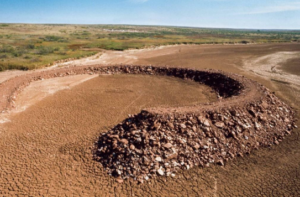
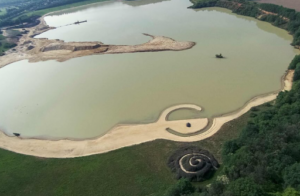
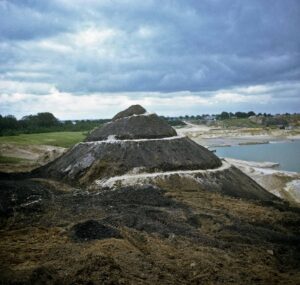
Famously known for his ‘land art movement’ and his series of large-scale sculptures called ‘Earthworks’, Smithson deeply engaged with the idea of the earth as raw material, as both the palette and the canvas, where the spirals that he created with sand and mud and rock and stones, offering an open-ended perspective, became symbolic of the malleability of form and the solidity of time. Smithson is aware of how much the earth percolates into life even when we don’t see it. ‘Even the most advanced tools and machines are made of the raw matter of the earth… tools are undifferentiated from the material they operate on, or they seem to sink back into their primordial condition…is entropy of technique leaves one with an empty limit, or no limit at all. All differentiated technology becomes meaningless to the artist who knows this state’.
The Surrealist Sediment
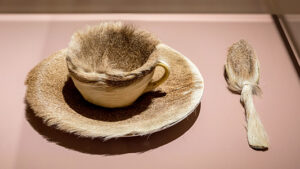
In Swiss surrealist artist and photographer Meret Oppenheim’s works, it is the conscious addition of layers that bring to life the crust one needs to dig through to come to an original and inspired strain of thought. More and more, as our worlds become muddled with information, journeys of excavation into the mind are becoming both tedious and problematic. Oppenheim, who shot to fame with her surrealist work titled ‘Object: Breakfast in Fur (1936)’, where she dressed up a teacup in fur, then, following its immense success as a symbol for bourgeois luxury and the growing
gap between the affluent and the poor, she chose to disappear from the limelight. ‘Object’ was a testament to the times she lived through—between the two World Wars—but it also became the cage that bound her to a single narrative of a ‘surrealist’, and one she worked hard to break through. In fact, she stepped on to the side and became the muse, the feminist object for photographs, most famously for Man Ray, and worked for many years as an art conservator as she continued to find her identity as an artist, refusing to succumb to a category, even if it meant several years of struggle and pain to overcome her own sense of self and what it meant to ‘belong’.
A Splash of Colour
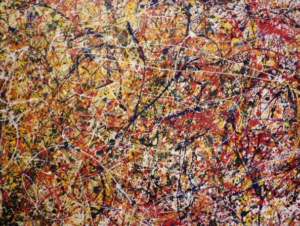
In Jackson Pollack’s works, the whole world becomes the canvas, in a literal sense—he belongs to the painting and the painting belongs to the world. His often large canvases embodied his physical grit and the unique method of painting a vision bound to who he was. Often called ‘action painting’ as he physically moved around the canvas stretched across the floor of his living room or
propped against the wall, and using his method of ‘drip painting’ where he let the paint drip from different spaces on the canvas. Eschewing the paintbrush for sticks, knives or trowels instead,
Pollock would allow the paint and the canvas to interact in ways that somehow felt larger than the artist and the art—it became a cosmic dance between the material earth and the spiritual
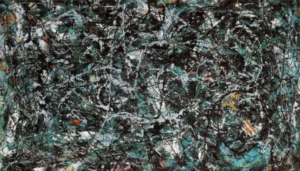
thought, deeply influenced by the times he painted in, post-World War II. ‘Jackson Pollock’s art tends toward a torrential sense of material that makes his paintings look like splashes of marine
sediments. Deposits of paint cause layers and crusts that suggest nothing “formal” but rather a physical metaphor without realism or naturalism. Full Fathom Five becomes a Sargasso Sea, a dense
lagoon of pigment, a logical state of an oceanic mind,’ said Smithson in his essay. From his ‘drip and splash’ technique, Pollack eventually moved to a more controlled form of painting, that was not
in any way restrictive or indicative of external mainstream pressure, but rather a maturation of his own thought process, a willingness to imprint in his paintings a sense of time and space through
motifs and symbols that continue to remain abstract, and yet, impose meaning through powerful strokes. His largest painting commissioned by Guggenheim Museum, titled ‘Mural’, was painted on linen that was 8 ft x 19 ft in size, his largest canvas, and while a lot of it was done using a paintbrush, you can still see patterns of his ‘splash’ technique. ‘e rational idea of “painting” begins to disintegrate and decompose into so many sedimentary concepts,’ added Smithson on Pollack. And Pollack himself said, ‘e painting has a life of its own. I try to let it come through’.
Symmetrical Resonance
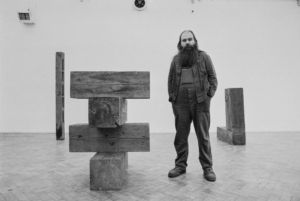
From the fluid, deliberately inchoate world of Pollack, we come to the symmetrical world of Carl Andre, embroiled, in his later life with the death of his third wife, artist Ana Mendeita. He
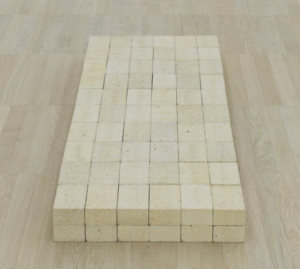
was eventually tried and acquitted. Andre, sculptor and poet, however, burst upon the world of art with what Britain’s Daily Mirror called, ‘What a Load of Rubbish’. ‘My grandfather was a bricklayer and a small contractor. [My family] were petty bourgeois craftsmen. So everything was about matter: bricks, mortar, steel plates. My earliest memories were of these things,’ he said in
an interview to Jonathan Grin. Daily Mirror was reacting to Tate’s acquisition of Andre’s work titled ‘Equivalent VIII’, a sculpture of 120 re-bricks stacked in a rectangular pattern, innocuous in its presence and yet intriguing in its apparent relationship to the viewer and the ground on which both the sculpture and the person stand. Andre, who worked both in publishing and as a railway freight brakesman and conductor, was often fatuously termed ‘minimalist’. There is a defiance in his simplicity, a living symbol for the ordinariness and drudgery of everyday life, far away from the fantastical imaginative world of artists. e material is so basic—steel, wood, stone—that art itself collapses in meaning. ‘Carl Andre’s “grave site”—a tiny pile of sand, was displayed under a stairway at the Museum of Contemporary Crafts last year (1967).
Andre…is more concerned with the elemental in things. Andre’s pile has no anthropomorphic overtones; he gives it a clarity that avoids the idea of temporal space. A serenification takes place,’
said Smithson in his essay. is serenity is concerned and reflective of the serenity of time—there is no rush, there is no urgency, there is only material and thought, land and identity, belonging and hope. Smithson’s essay from six decades ago are echoes of the world we inhabit today, where the rubble of history, the death of morality and the tentacles of evil and darkness become the remains of memory, where both the ideal and the ordinary overpower the abstract notions of a crumbling mainstream narrative. Smithson, perhaps, said it the best: ‘The strata of the Earth is a jumbled museum. Embedded in the sediment is a text that contains limits and boundaries which evade the rational order, and social structures which confine art. In order to read the rocks, we must become conscious of geologic time, and of the layers of prehistoric material that is entombed in the Earth’s crust. When one scans the ruined sites of pre-history, one sees a heap of wrecked maps that upsets our present art historical limits. A rubble of logic confronts the viewer as he looks into the levels of the sedimentations. e abstract grids containing the raw matter are observed as something incomplete, broken and shattered’.