


Black Magic
What does “home” mean for a craft that has wafted over the seas and rooted itself in a sleepy town?
By Meera Rajagopalan
Bidar seems like that overambitious kabaddi raider who failed to make it to his home side. The sleepy Karnataka town, just a few kilometres from the Telangana border and 140 kilometres from Hyderabad, has much of its culture and history linked with the metropolis.
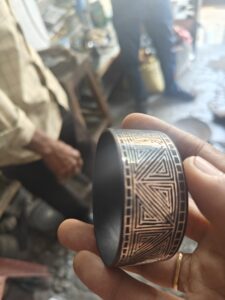
What it’s most known for, however, is the craft it has lent its name to: Bidriware, a beautiful metalcraft with a distinctive look of intricate silver inlay on a blackened alloy.
Like Madhubani, Kolhapuris, and Kanchivarams, GI-tagged Bidri is inextricably tied to place—perhaps more so. The mitti (soil) of Bidar—specifically, from a particular area of the Bidar Fort—is used in the final step of the craft to reveal its characteristic look.
When I visit the studio of the late Mohammed Rauf, a much-decorated master craftsman and winner of the AD X JSW Prize for Contemporary Craftsmanship, we are examining the process itself—for inefficiencies, inadequacies, and possibilities. Taher Siddiqui, of multi-generational Mahboob Bidri Crafts, is intent on shaking things up and shows us around the dusty workshop where copper-zinc alloy is heated in a furnace and sandcast into a mould. The product is removed from the sand, like a newborn. Less-than-a-millimetre-thick designs are engraved onto the surface, silver wire inlaid into the grooves, and the whole piece is buffed.
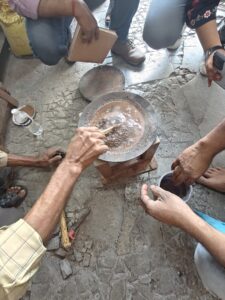
We then move to the studio, where Rauf extracts a portable stove from a crevice. One of his sons prepares a mixture of fort mud, water, and ammonium chloride and heats it. “We have to get the mud without the ASI security seeing us,” someone whispers, but I do not turn, lest I miss the magic.
A bangle, still a very monoethnic white-on-white, is dipped in the mixture. Like a magician, as the master craftsman swirls the bangle around the heated mixture, I wait. Finally, he extracts the bangle from the mixture with a flourish. The bangle has turned a multiracial black and white. The silver, like a steadfast Bidri artisan, stays as is, unaffected by the happenings around it, but the copper-zinc alloy has turned black.
Bidri has travelled the world, changing names and forms along the way. It was brought to India by artisans who accompanied the Bahmani rulers of the 14th–15th centuries who set up base in Bidar. At the turn of the 19th century, there were an estimated 400 artisans in Bidar; now, fewer than a handful actively pursue it. A slew of government programs failed to revive the craft, and like many others across India, it is bleeding out as young men leave for other jobs.
“See this street?” Rauf points to the lane where the Bidri showrooms are, in sepia, a layer of dust on them. “Used to have many studios. Now, you’ll only see old men like me.”
That might soon change. A new crop of artists is reimagining Bidri for contemporary contexts, working alongside master craftsmen.
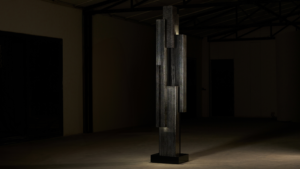
Nolwa Studio by Rohit Naag is one such example. Their recent four-piece Bidri Collection—featuring international designers like Gunnar Rönsch and Stephen K Molloy of Germany and in collaboration with Rauf—caught attention at the India Art Fair. Their bar cabinet Liminal fuses Bidri into a striking wood composition. Sculptor Stephen Cox’s Bidri Bottle, exhibited at Evoke London for London Craft Week is part of a collection of Bidri work.
Siddiqui, whose family moved to Hyderabad decades ago, encouraged by the Nizam, does not like status quo, and wants to innovate. He is looking at artisan safety, working with large pieces rather than smaller ones, and enabling technology. “There is so much that needs to be done. I cannot just let it go,” he says, “I have a connection to the craft.”
What remains unsaid is that to succeed, like an immigrant seeking greener pastures, Bidri may have to leave home. Everyone knows it’s a chemical reaction that creates the blackening. That chemical—present in the soil of the Bidar Fort—has even been identified in studies.
Why not, ask many. In some sense, it already has, as many artisans have moved to Hyderabad.
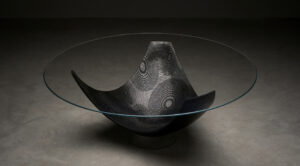
Arjun Narne, General Secretary of the Crafts Council of Telangana, puts it plainly: “If the soil of Bidar is unique for this craft, then where did the Persians get that soil from? The origin aspects are best left to academicians and historians. We must look at how the craft will grow while broadly retaining its identity.”
Yet, crafts are rooted in place in ways few other art forms are. There are stories of Bidri not surviving elsewhere, like angelfish that can’t survive in lakes. Master craftsman Mohammed Kareemuddin, 78, recalls a group who moved to Aurangabad. “They thought it was easy—that they could make it anywhere. But it didn’t work like that.”
But that’s no longer the case, many believe, and this isn’t just moving an artisan colony, it is reimagining the scale and application of the craft.
“As a craftsman grows confident and experiments, he will have his own space—call it a Studio, Karkhana, or Atelier. There is a quiet metamorphosis from craftsman to artist,” says Narne, adding that “origin aspects are best left to academicians and historians to research over.”
As we wind down after examining the process for artisan safety and efficiency, I wait at Rauf’s family showroom, one that has clearly seen better days. Moulds, plates, and even Rauf’s State Award adorn the walls.
A group of tourists enters, guided by a local. They gaze at the Bidri plates. The guide explains: “Ma’am, we saw this in the Fort, remember? Where I told you artisans come and steal the soil from the Fort? They use that soil to make these.”
Share