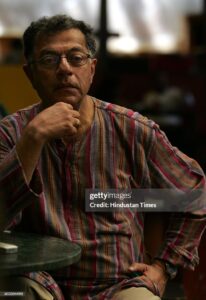
Girish Karnad: The Storyteller as Mirror, Mythmaker, Modernist
A journey into narrative as dialogue—where myth breathes, truth flickers, and the listener becomes part of the tale being told.
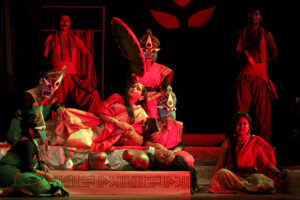
Every era finds a voice that doesn’t merely reflect the times but rewrites its language. In modern Indian theatre, Girish Karnad was that voice. Playwright, actor, director, thinker—his legacy transcends mediums, but it is in the realm of stories that his genius truly shines. His was a theatre of thought, of introspection, of confrontation, and, perhaps most powerfully, of listening. In a cultural climate saturated with spectacle, Karnad believed in the quiet, insistent power of the narrative—not as an ornament but as an instrument. His plays were not stories told to us. They were stories told with us.
And in that space—between teller and listener—he built one of the most important bodies of work in Indian dramaturgy.
A Theatre of Many Tongues
Born in Matheran, Maharashtra in 1938 and raised in Dharwad, Karnataka, Karnad inherited a rich linguistic and cultural legacy. Kannada was the language of his heart; English, the language of his education. He moved between them not out of necessity, but intention. In many ways, this duality—this borderlessness—defined his approach to storytelling.
Karnad never wrote plays to entertain. He wrote to engage. To provoke. To examine the structures—political, social and personal—that define and confine us.
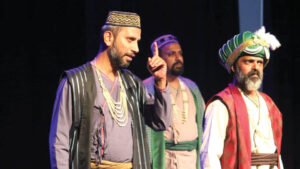
Take his early masterpiece, Tughlaq (1964). Ostensibly about the 14th-century Sultan Mohammed bin Tughlaq, the play is a dense political allegory. Written in the wake of India’s post-Independence disillusionment, it captures the descent of a brilliant but idealistic ruler into tyranny. But more than that, it is a meditation on the fragility of utopian vision, a study in how power warps idealism. And even today it echoes everywhere from university stages to national theatres because its questions remain hauntingly relevant.
The Mythic and the Modern
Karnad’s true genius, however, was in how he wielded mythology and folklore—not as decorative backdrops, but as living, breathing structures through which contemporary dilemmas could be refracted.
Hayavadana (1971), one of his most celebrated works, is inspired by Thomas Mann’s The Transposed Heads, which in turn draws from a tale in the Kathasaritsagara. But Karnad reimagines it through the lens of Indian folk theatre—particularly Yakshagana—and infuses it with existential inquiry. What makes us human? The mind, or the body? The heart, or the intellect? It’s a love triangle, yes, but also a fable of identity, desire and the brokenness of being whole.
Then there’s Nagamandala (1988)—perhaps his most lyrical work. Framed by the story of a woman cursed to listen to stories every night or die, it explores the inner world of a neglected wife whose fantasies (or are they realities?) intertwine with folklore. In this play, Karnad doesn’t just retell myths—he listens to them. He lets them evolve, become political, become feminist. He gives voice to the silences women carry, and in doing so, allows myth to become resistance.

The Story That Watches Back
Karnad’s plays exhibit not just their narrative complexity or historical settings, but also their ethical urgency. His stories watch us. They ask us to think not only about the characters on stage but about the roles we play in society.
In a world where stories are often flattened for ease or consumed for escape, Karnad insisted that the story be a mirror, not a mask. His theatre was not escapist—it was experiential. The audience was not a spectator, but a participant.
In that sense, he wasn’t just a storyteller—he was a story-listener. Every myth he reinterpreted, every character he gave voice to, was rooted in the belief that narratives are not fixed. They evolve. They are built through listening, through dialogue, through memory.
And isn’t that what we need now more than ever?
Stories as Resistance, Stories as Return
The theme of this issue—Stories—asks us to reflect on the power of narrative as a meeting point: between artist and audience, between silence and speech. Girish Karnad’s work lives at that intersection.
Very few Indian artists have so deftly straddled the traditional and the modern. He was as comfortable invoking the Mahabharata as he was critiquing nationalism. His plays spoke to the moment, but also reached beyond it—across generations, regions and realities.
And while he worked in cinema (winning acclaim as both actor and director), and served in public intellectual roles, his deepest artistic contribution remains theatrical. Because, theatre—live, ephemeral and communal—matched his own belief that stories only exist when shared.
The Curtain Never Really Falls
When Karnad passed away in 2019, the country mourned. Not just the loss of a playwright, but of a public thinker. A man who believed that art could confront, could change, could challenge.
And yet, his stories have not gone silent. They are still performed, still debated, still reimagined by young theatre makers. They still whisper to us: Where do you stand? What do you believe? Whose story are you telling?
In a crumbling, raging world, as this issue puts it, stories remain our most human response. Karnad knew this. He believed in the power of myth to speak the truth, and the power of truth to rebuild myth.
Every play he wrote is an invitation—to reflect, to listen, to remember.
Because, in the theatre of Girish Karnad, the story never ends. It just waits—for the next voice.