


Tales That Twist. Lies That Linger.
Blurb: Walls have ears, hills have secrets, and Berlin knows how to keep them both. Here, buildings wear masks; and the most fascinating stories are hidden behind their façades.
– Vani Sriranganayaki
If cities could lie, Berlin would be the world’s most convincing actor.
I once walked the streets of Berlin expecting history. To be fair, in Berlin, history is around every corner. But what I also found was theatre. A city dressed in stone and silence, performing only for those who dared to look twice.
Berlin carries its scars the way a veteran wears medals–not proudly, but pointedly. The craters in its memory are paved over with museums, graffiti and shiny new buildings. And yet, something lingers beneath the surface. A heaviness. A whisper.
You can feel it in the quaint little cafes and the trendy pubs, the restored and painted-up museum walls. You sense it in the quiet hum of façades that boast German perfection—walls that are too symmetrical to be honest. The past here isn’t gone. It’s repurposed, repainted, repackaged. But never revealed. Not entirely.
Because Berlin doesn’t just remember—it hides. And every time you think you understand it, the city turns, reshapes the narrative, and leaves you questioning:
What is real? And what is merely… well-constructed?
The Hill That Shouldn’t Be
On a clear afternoon, as you walk along the pine-needled paths of Teufelsberg you may feel the crisp breeze of Berlin’s Grunewald Forest. The summit offers panoramic views of the city’s sprawl. Hikers laugh. Cyclists pass by. The grassy slopes roll on like any other natural hill.
But none of it is real.
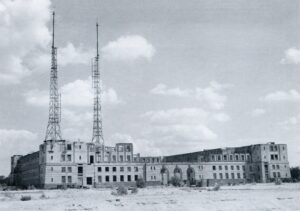
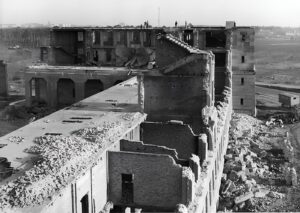
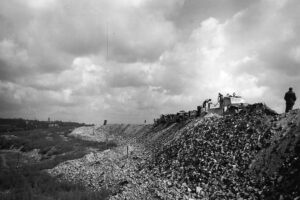
Beneath your feet lies 75 million cubic metres of war-torn debris packed into the earth—the shattered bones of a broken Berlin. And beneath that entombed in concrete and secrecy, rests the skeletal ghost of a Nazi dream: Albert Speer’s Wehrtechnische Fakultät. It was meant to be the heart of a vast university complex in Hitler’s megalomaniacal vision for Welthauptstadt Germania. But fate—and the war—stopped it mid-beat. Only a shell was built. A shell so defiant, so brutally reinforced, the Allied forces declared it ‘too tough to tear down’. So, they buried it alive.
Following the Berlin Blockade, from 1948 to 1972, debris from across West Berlin was carted to the site. Truck by truck, the dead weight of history was laid upon it. The hill grew, swallowing the academy whole. They named it Teufelsberg—Devil’s Mountain—as a nod to the dark heart entombed within.
The trees came later, planted to stabilise the mound and soften the lie. A ski lift was added. Jogging trails carved in. Tourists snapped selfies, never suspecting that the very ground beneath them was artificial.
And so, Berlin emerged from the war as the city where even architecture played double agent.
The Tower That Watched
By the early 1960s, Berlin found itself severed—West and East, NATO and Warsaw Pact, liberty and surveillance. The Cold War’s silence needed ears, and Teufelsberg offered height, distance and just the right acoustic isolation.
That’s when the white domes appeared.
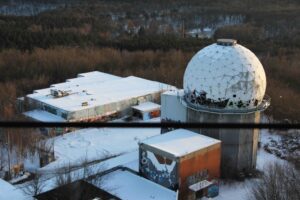
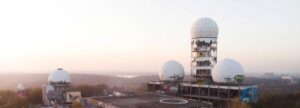
They looked like part of a modernist dream—futuristic bubbles dotting the forest skyline. Officially, this was a United States ‘listening post’. Unofficially, it was Field Station Berlin, a top-secret NSA surveillance complex. Inside those domes were antennae so sensitive they could capture microwave transmissions bouncing off the clouds over East Berlin.
The architecture was deliberate. The domes were radomes, designed not to protect the instruments from the weather, but to prevent the Soviets from knowing what instruments were inside.
Each room was soundproofed. The concrete corridors bent at odd angles to break echoes. Secret sublevels connected to bunkers. Doors locked with no labels. And always, the domes were listening, triangulating, recording.
The hill’s slope wasn’t arbitrary either. Engineers discovered that slight angles helped direct signal reception over the Berlin Wall and deep into Soviet territory.
A mountain was built on lies. And then towers were added to hear them.
The Village That Played House
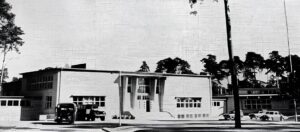
Just down the road, past the wooded trails, where the forest thinned and the city forgot its edges, sat Hüttenweg or ‘Hut Road’. A quiet stretch of tree-lined, suburban houses. Perfect hedges. American-style porches. Not a facade out of place.
But in Cold War Berlin, nothing was ever just what it seemed.
The houses stood still, but something buzzed beneath—not quite sound, not quite silence. A hum too low to hear, too constant to ignore.
There are no records saying that spies lived here. Only rumours. And back then in Berlin, rumours mattered more than the truth. The village played its part—a set dressed in suburbia, waiting for its cue. To do what? No one ever found out.
And so, once again, architecture spoke in silence—weaving power into porches, threading control through curtain seams, supposedly hiding surveillance behind the illusion of suburbia. Even picket-fence Americana became a line in a script.
And the houses? Just actors in a quiet play of dominance.
The Echoes That Remain
When the Berlin Wall fell in 1989, the Cold War’s secrets began to crumble. By the mid-1990s, Field Station Berlin was abandoned. Military personnel vanished. Files disappeared. The radomes stood empty, their antennas dismantled.
And then, the city crept back in.
Graffiti artists painted murals across the walls. Urban explorers wandered the dark halls. Photographers documented rusted control panels and shattered monitors. The site, once protected by armed guards, now echoed with spray cans and drone flights.
But even in ruin, Teufelsberg whispers. The acoustics in the main dome are uncanny—stand in the centre, speak, and your voice rebounds back to you in eerie clarity. Some say it’s like hearing your soul echo. Others say it’s the building talking back.
Maps were found behind panels—schematics of East Berlin buildings. Files with redacted names. One mural simply reads: ‘Truth is layered’. Even abandoned, the architecture performs.
The lie outlived its use—but not its power.
Most architecture is designed to reveal—to declare purpose, power, identity. But Berlin’s most fascinating structures are designed to conceal.
Teufelsberg is a perfect architectural ouroboros: a Nazi building hidden beneath a Cold War station pretending to be something it wasn’t. And now, both are wrapped in a park that invites you to forget what lies beneath. Teufelsberg isn’t just built on ruins; it is the ruin, the burial, the rebirth, and the ongoing performance—all at once.
This is not accidental. Berlin’s urban evolution has always wrestled with memory—what to preserve, what to erase, what to hide in plain sight. In a city that’s been bombed, divided and reconstructed, architecture becomes a form of psychological survival.
Buildings here don’t just tell stories—they protect, distort and even rewrite them.
Teufelsberg is not alone.
Berlin is littered with facades and fragments of a past it tries both to confront and to forget. Nazi-era buildings repurposed as schools. Soviet bloc housing now painted in pastel colours. Cold War bunkers turned into nightclubs.
Even the Berlin Wall itself—a structure of division—was an architectural illusion. To outsiders, it was a single barrier, a chunk of the iron curtain. In truth, it was a layered system: outer wall, kill strip, patrol path, inner wall. What you saw was never all there was.
This is why Berlin is a city that rewards curiosity. Because here, façades are just the beginning. The truth lies underneath—in some cases, literally.
At Teufelsberg, architecture became an active participant in history. The buried Nazi academy was an erasure. The spy station, an actor. The village, an illusion of a stage. Each piece of architecture didn’t just exist; it performed. It told a story, delivered a message, masked a secret. Berlin, perhaps more than any other city, teaches us this: that built space is never neutral. Every brick carries an intention. Every façade, a motive. Every wall, well, ears.
That sometimes, the most truthful thing architecture can do… is lie.
Share