


A Sublime Symphony in Stone
Among the greatest cultural legacies of India, the caves of Ellora, near the city of Aurangabad, stand as a testament to shared devotion and sculptural brilliance.
By Sonia Kapoor
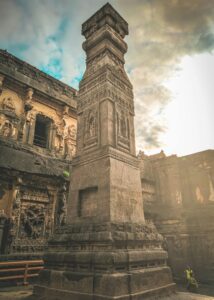
Centuries ago, master artisans worked tirelessly on the volcanic cliffs of the Deccan plateau in Maharashtra, near present-day Aurangabad. What followed was an extraordinary feat of imagination and endurance that transformed the basalt stone mountains. Thirty-four rock-cut sanctuaries were sculpted over four hundred years that became one of the greatest artistic legacies worldwide.
In the present day, Ellora caves stand as one of the most notable triumphs of sublime creativity. This monumental ensemble weaves together the spiritual lineages of Buddhism, Hinduism, and Jainism in stone forms that transcend faith. More than architecture, Ellora is a story etched into the earth, crafted by skilled hands, and meant to last forever. The carvings on stone speak of faith, ingenuity, and the profound patience of time.
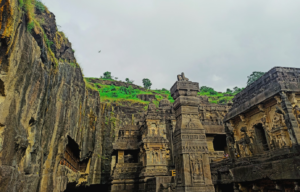
It is said that generations of artisans, without any guidance of a blueprint, showcased their harmonious craftsmanship by creating a living museum, carved entirely from stone. They worked with minimal tools such as hammers and iron chisels of varying widths. But it was their acute understanding of geometry, perspective, and the natural grain of basalt that allowed them to carve minute details and that too on a mammoth scale. There were no second chances—one misplaced blow could compromise an entire surface.
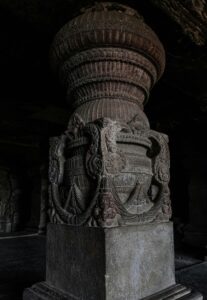
The story of Ellora unfolds between the 6th and 10th centuries CE, a span that witnessed the zenith of Indian rock-cut architecture. Art historians have noted that the precision of Ellora’s sculpture suggests a highly trained guild system where skills were passed down through generations, possibly linked to temple-building traditions of the time.
Through centuries, Ellora stayed accessible and active. Situated along ancient trade routes, it welcomed monks, merchants, and poets. The enclosed shrines echoed with the footsteps of pilgrims and the rhythms of ritual. It was never merely a place of worship, but a cultural crucible where creative vocabularies evolved and merged.
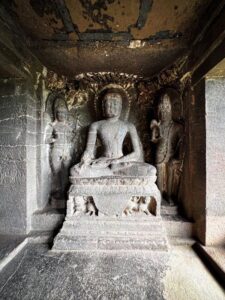
Though the chisels have since long fallen silent, the story of the rock-cut caves continues. Scholars, worshippers, and travellers still walk its corridors, tracing the arc of India’s religious imagination through its walls.
This UNESCO World Heritage Site holds not only the monuments of faith, but various chapters of a book in a grand civilizational narrative, where religion, art, and architecture converge in a seamless, enduring flow.
For readers of arts and heritage, Ellora is a revelation of the Buddhist calm, the Hindu grandeur, and the Jain precision. Each style is distinct, yet intricately intertwined in spirit and stone.
The entire complex comprises of three parts: twelve Buddhist caves to the south, seventeen Hindu caves at the centre, and five Jain caves to the north. The transitions are not clearly demarcated, but elegantly progressive, as if echoing the shared cultural soil from which they emerged.
- The Buddhist caves focus on the bodhisattva ideal, where compassion and wisdom are reflected in calm, frontal figures.
- The Hindu caves embody movement, narrative, and cosmic dance, seen in the depictions of Lord Shiva as Nataraja (lord of dance) or Lord Vishnu in his many avatars.
- The Jain caves represent symmetry and abstinence, where precision becomes the highest aesthetic ideal
Buddhist Caves
The Buddhist caves belong to the earliest phase of construction and include viharas (monk residence halls) and chaityas (prayer halls). The caves depict powerful expressions within the sculptures and carvings that showcase Buddha figures, Bodhisattvas like Maitreya, Vajrapani, and Manjushri, as well as Buddhist deities.
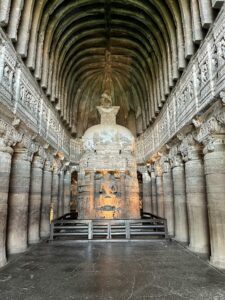
Prominent among the Buddhist caves is Cave 10, also known as the Vishvakarma or Carpenter’s Cave. This is perhaps the most iconic, and features an elevated chaitya hall with a vaulted ceiling that mimics timber architecture. At the centre is a chiselled form of a seated Buddha in a preaching posture.
The central group of Hindu caves are both mythological canvases and feats of engineering carved in the form of legendary Hindu temples. Kailasa Temple (Cave 16) is the most impressive, being the largest monolithic temple in Ellora, exhibiting intricate stonework and architectural grandeur. Inspired by Mount Kailash, the abode of Lord Shiva, it was carved top-down from a single rock cliff and is popular for its elaborate carvings, life-size elephants, and soaring pinnacles. It is said that over 200,000 tonnes of rock were excavated to create Kailasa.
Other noteworthy Hindu caves famed for their sculptures and carvings include Cave 15: Dasavatara or the Cave of Ten Incarnations that features depictions of Vishnu’s ten incarnations; Cave 21: Ramesvara known for its carvings and depictions related to Shiva; and Cave 29: Dumar Lena, which is an example of Brahmanical caves.
Share