


Motifs and Modernity of Northeast India
Northeast India has evolved in its meaning of designs and that is possible due to the young designers in the region. Every motif traditionally rooted is now carried forward for reimagination.
By Pinaz Ahmed
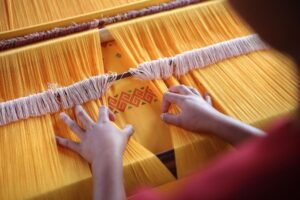
“For me it is not just about holding on to the traditions, but to push it forward. I always wanted to create designs for women through which they can speak their story to the world. I want them to feel lighter, something a woman can move in, own, and feel powerful in everyday clothing.” — Pranami Mahanta, Founder & Designer, Ameya
Northeast India is a heaven on earth, with rivers humming folklore, mountains holding silence through green lushes, and textiles speaking in motifs. Each motif used in the region speaks of a story of its own—the Kopou phool (orchid) speaks to the coming of spring, the elephant walks in rhythm through the borders. Tradition here is tactile, and with each touch, modernity flows in, so do new visions.
At the heart of this new vision and reimagination, Pranami Mahanta, a young designer and founder of the label Ameya, is redefining the way Assamese women connect with their attire—one motif at a time. During our interview, she expressed that in today’s world, women look to wear a piece where designs are traditional yet modern in their approach.
Mahanta takes inspiration from her artistic intuition and rich diversity of motifs found across different cultures. Her travels, both national and global, are driven by the curiosity to understand the symbolic foundations of designs across geographies. Transformation in designs will come with the growth of modernism, and a similar impact is seen around the wearer of Northeast Indian states.

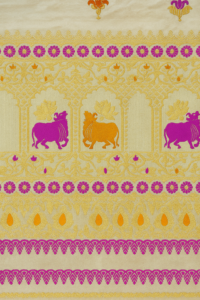
One of her most compelling innovations is the addition of Pichwai motifs (inspired by traditional Rajasthani design) as motifs of sador mekhela (traditional attire of Assamese women). A design which she has redefined through the figure of the bull—her version inspired by Nandi, the sacred vahana of Lord Shiva. Traditionally considered sacred and even off-limits in Assamese weaving, Mahanta transforms this bold motif into a symbol of power, determination and feminine strength that speak of the identity, strength and aspirations of modern women.
Another powerful reinterpretation of Assamese traditional motifs is the pigeon. Once upon a time, it symbolised the act of peace and freedom in ceremonial attire, Mahanta now uses it in everyday wear to reflect the hunt for identity and liberation from societal norms. Her pigeons fly across shoulder drapes and sleeves, or are tucked gently into borders, silent but expressive.
In Assamese tradition, the flower and tree designs once symbolised the beginning of a new season. In today’s contemporary world, it has been used as a metaphor for women balancing self-rooted identities in the modern world, while keeping a sense of appreciation for roots.
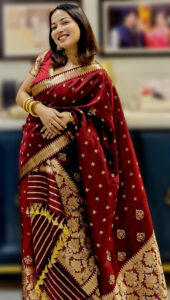
“Design, for me, is a mode of language; it is a way for women to bring out their stories without saying a word. Every motif Ameya chooses, every thread we weave, is a reflection of power, roots and change. I am not only working on preserving traditional motifs, but I want to reimagine them so that it gives a meaning to our everyday lives. At Ameya, I ensure that my designs are able to bring tradition and modern life together.” — Pranami Mahanta
In today’s women-centric society, the transformation of design is no longer an option—it is essential. “I want my designs to imprint belief, not just beauty. By placing Pichwai motifs on a modern sador mekhela, with light fabric, I’m telling women that what was once ‘forbidden’ is now a symbol of strength”, she says.
The shift in design preferences among today’s generation is not just artistic, but sociocultural and personal. A society where heavy designs and fabrics like ‘Muga’ and ‘Pat’ have always been reserved for ceremonies, Mahanta dreams of a world where women wear sador mekhela to brunch, to work or even to global fashion events. With a fresh eye on symbolism, Mahanta is giving new life into the aesthetics of Assamese motifs, creating designs
As Northeast India continues to reach the mainstream fashion world, designers like Mahanta made sure that its entry is not through claims, but through articulation. Her reinterpretations are not about modernising motifs for the sake of trend, but about finding new relevance for an audience who seeks meaning in what they wear. As the Northeast steps into the spotlight of global fashion, designers like Pranami Mahanta let tradition speak—not through noise, but through thoughtful design. Her work doesn’t just follow fashion—it tells stories.
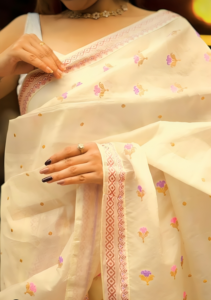
There is a moment Mahanta recalls with quiet pride—a young bride choosing to wear a sador mekhela designed by Ameya on her honeymoon. Not for a ritual, not for the sake of tradition, but simply because it made her feel beautiful, free and herself.
Motifs once told stories of seasons, life cycles and customs. Today, they whisper new meanings of hope, freedom, power and identity. The Kopou is no longer just a flower, but a symbol of becoming. The elephant now marches not in royal processions, but beside women carving paths of their own. In every design, old stories find new voices. Through Mahanta’s designs, the meaning of transitional design has got a new life—it transforms. It grows with the women who wear it, soft yet strong, rooted yet new. The past is not left behind; it walks ahead, reimagined in every shade, in every fabric and in every motif.
Share