


Myth Made Tangible
In a world increasingly severed from its ecological and mythic roots, A. Ramachandran’s art unfurls as a verdant palimpsest—where sacred trees, ancient myths, tribal memory, and painterly opulence coalesce to reclaim Indian visual heritage as a sensorial, evolving continuum between the real and the remembered.
By P Abigail Sadhana Rao
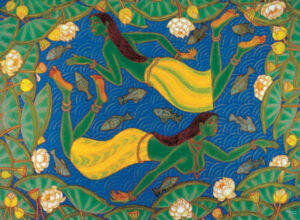
Two Girls Swimming in the Lotus Pond (2002), Oil on canvas. Photo: Courtesy Art of Ramachandran
There’s a particular kind of silence that follows devastation—the kind that lingers after the fall of an old tree or the flight of startled birds. From the cries of peacocks at the University of Hyderabad as bulldozers decimate sacred groves to the clearing of the Amazon for a climate summit to accommodate policy discussions to save them, these paradoxes reflect a world where trees are more often spoken for than truly heard. Trees that once held nests, shade, and stories became felled trunks—unjust casualties of bureaucratic indifference masquerading as development. This incongruity feels almost satirical—were it not so devastating.
In moments like these, A. Ramachandran’s art becomes all the more relevant and vital. His lush, immersive paintings are not mere simple aesthetic marvels but fierce acts of remembrance reflecting an eternal cycle of creation and decay. To step into his world is to enter a space where art is not merely a reflection of reality but an exaltation of its most profound elements. His canvases pulse with life, a visual rhapsody where flora and fauna transcend their roles as passive elements and become the very essence of storytelling. Drawing deeply from India’s mythological past, he reinterprets his vision through the prism of the present. Through his art, he challenges us to reclaim that sacred gaze—to see nature not as a resource but as a source of life through which nurturance ebbs and flows.
Inspirations That Shaped His Vision
Ramachandran’s trajectory is a fascinating evolution that mirrors the shifting tides of his philosophical and aesthetic inclinations. His compositions were shaped by the influence of Mexican muralists and rooted in post-independence struggles—which then evolved to a luminous, symbolic language inspired by India’s classical and folk traditions. A turning point came with his discovery of Ramkinkar Baij’s Santhal Family, which sparked a lifelong fascination with the Santhal tribe’s organic aesthetics and reverent bond with nature. Their uninhibited visual culture and mythic worldview deeply informed his evolving style. The murals of Ajanta, the temple frescoes of Kerala, and the fluid lyricism of classical Indian miniatures became his new lexicon. He began to see art as a medium for commentary and as a celebration—an immersive, poetic experience that could uplift the human spirit.
Reviving Lost Dialogue
Historically, Indian art has embraced the natural world—not as mere decoration but as an intrinsic part of spiritual, mythological, and everyday narratives. However, as Indian contemporary art veered towards abstraction and conceptualism, this deep-rooted connection with the organic world began to wane. Ramachandran’s revival of nature as a central motif on a large scale reminds us that Indian art is not just about form but about experience, about the interconnectedness of human life and the environment that sustains it.
Unlike many artists who use nature as a secondary motif, he gave it centre stage. His landscapes are dynamic ecosystems, teeming with motion and presence. Every leaf, every petal, every droplet of water is rendered with an attention to detail that speaks to his deep reverence for the natural world. Ramachandran’s artistic oeuvre is best understood through the lens of some of his works that encapsulate his unique philosophy and thematic preoccupations.
Yayati Series: The Myth Reimagined

Sandhya (Last section of Yayati), (1986), Oil on Canvas. Photo: Courtesy Art of Ramachandran
Ramachandran’s Yayati series is a sweeping and masterful reimagining of an ancient myth that transcends its narrative roots to explore the eternal human tensions between desire and renunciation, youth and decay, indulgence and awakening. Spanning twelve monumental painted panels and a central ensemble of thirteen bronze sculptures, the series unfolds like a visual epic—each frame steeped in symbolism and charged with emotional intensity. Ramachandran doesn’t merely illustrate the story of King Yayati; he excavates its philosophical core, casting it into a contemporary light where the hunger for power and pleasure remains insatiable yet ultimately futile.
The presence of trees is not incidental—it is fundamental to depicting the whole narrative. Nature, particularly the arboreal, becomes a silent yet potent witness to Yayati’s turbulent journey from indulgence to renunciation. Trees appear as living entities—gnarled, towering, sensuous—intertwined with human forms and emotions. Their roots coil like ancient memory, and their branches stretch across the panels like arteries of time. With rich, vibrant colours and forms that echo classical Indian mural traditions while embracing modern psychological depth, Yayati becomes both a personal and collective mirror—one that reflects our ongoing struggle to balance the material and the spiritual, reminding us, through myth and mastery, that the path to fulfilment often lies in surrender.
Nature as Living Mythology
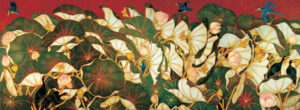
The Lotus Pond in the Monsoon Breeze (2001), Oil on canvas. Photo: Courtesy Art of Ramachandran
Lotus Pond series is a lush, immersive tribute to nature’s intricate rhythms, inspired by the rural landscapes of Bengal and Jharkhand. Blending the botanical precision of Mughal miniatures with a grand, dreamlike scale, the works overflow with life—lotus blooms, dragonflies, birds, and fireflies—rendered with hypnotic beauty. Yet beneath their visual splendour lies a quiet sorrow, as the series doubles as an elegy for India’s vanishing natural sanctuaries threatened by urbanisation. Rooted in years of devoted observation and meditative engagement, Ramachandran’s practice reflects a profound reverence for nature’s cycles, capturing not only what is seen but what is felt—and increasingly, what may soon be lost.
Where Myth Breathes through Leaves
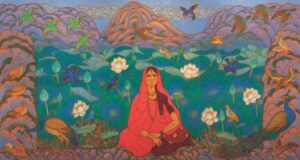
Ekalinji Fantasy (2014), Oil on canvas. Photo: Courtesy Art of Ramachandran
In Ekalinji Fantasy, A. Ramachandran conjures not a literal depiction of the ancient temple town but a richly imagined dreamscape where nature and the sacred exist in seamless harmony. Architectural forms dissolve into the organic pulse of the earth—vines entwine temple pillars, lotuses bloom in tranquil waters, and trees thrum with life—evoking a primordial world where mythology, memory, and ecology are deeply intertwined. Drawing from the narrative depth of temple murals and miniature paintings, Ramachandran reimagines divinity not as distant or monumental but as intimate and alive within the rhythms of nature. This fantasy is not escapist but a return to a more profound truth, where beauty, decay, and spirituality coexist in quiet dialogue. With this work, Ramachandran channels the soul of Eklingji, offering a luminous meditation on the unity of the material and the mystical.
A Legacy Rooted in Reinvention
Through these works, Ramachandran redefines Indian artistic heritage—not as something to be preserved in stasis but as a living, evolving entity. Whether through mythology, nature, or folk traditions, his paintings challenge us to engage with the past with a sense of immediacy and personal resonance. His artworks not only depict but rather—they question, celebrate, and mourn, offering a visual language where heritage and contemporary reality exist in perpetual dialogue. In an era where Indian art often oscillates between hypermodern abstraction and nostalgic revivalism, Ramachandran’s vision stands apart: a masterful synthesis of tradition and reinvention, ensuring that India’s artistic consciousness remains rooted and ever-changing.