


The Flamboyance of Truth
In conversation with contemporary artist, Ganapati Hegde on all things nature, colour and that mysterious connection with truth that lives in a flower, a leaf an ant
Praveena Shivram
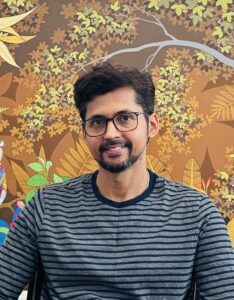
This interview with Ganapati Hegde happened amidst some obstacles. First it was construction outside his house. Then it was my missing laptop charger. And then it was just the timing and the day not aligning. But, finally, when we did speak, it became a reflection of how nature – his muse and landscape – itself functions. Nature follows its own plan and guidelines, its own rhythm and frequency, and its own process walking to the cadence of its own beat. Hedge’s art and Hegde himself are nature’s beings interacting with the confluence of comprehensive thought and the consecration of ancient truth. His visual language is full of rich colour, both the visible and the invisible, much like his career as an artist. A National Award winner, an artist with several solo and group shows in his pockets, an acclaimed national and international artist – Hegde’s art is a proclamation of intricate human longing, ambition, purpose, meaning built into the world of flowers and animals and trees and leaves, but Hegde himself is a picture of quiet, measured thinking, of a silence filled with words of collective reason and spiritual awakening. When he speaks there is an unhurried understanding of life, an urgency tamed and tempered into the will of doing, into the will of being. ‘My mother used to tell me how I was fond of the colour red. If I was crying, all she had to do was give me a piece of red cloth and I would be happy again,’ he shared, and within that simple sharing – and many more throughout this interview, is embedded the soul of Hegde and his art: mother nature, at its core, is simple for it lives in the experience of the divine.
Excerpts from the interview
The flamboyance colour is one of the first things we notice in your paintings. How would you describe your relationship with colour?
Basically, I come from a background of coastal Karnataka, where I was surrounded by a lot of colour in the form of folklore, music and Yakshagana, a traditional performance art form that I used to perform in my childhood. Somehow, these colours, over a period of time, and also through my education in art – multimedia, animation and graphics – have helped me a lot. Ultimately, it is all about connecting the dots of what all we experience. For me, colours are all about harmony. In fact, when we study the theory of colour, it is about balance. I particularly like working with tertiary colours, to look at the multiple colour coordinations within those shades.
You have often talked about being fascinated with the smaller creatures in nature – the insect, the lizard, the ant, rather than the tiger or the elephant. What attracts you to the smaller aspects of nature?
Yes, this is a long story. Once I completed my diploma in Fine Arts from the Ken School of Art, I worked on a series based on mythology and nature immediately after that, titled ‘Gods in Nature’, my first solo show. It was all about slokas and how we can give it a visual interpretation. A prominent art critic of the time gave the show a negative review saying this kind of art is not long-lasting. Of course I was disappointed and for a long time after that, I stopped working and started observing things in a different way. What is my nature, what and who am I, what is this being of mine – I started to question myself. Ultimately, art and who you are, your lifestyle and personality, do go together. I have always been an artist who takes time over every painting. I think in a detailed way, where colours, effort and thought culminate into one entity. It was a gradual development, and over a period of time, I started to see certain creatures in and around me. This was a slow evolution, not a sudden decision. I stayed true to what was around me – how does the chameleon behave and how can I bring that into my visual language? I started to represent these creatures in the best possible way, and for that series, I won a National Award. That gave me confidence and a boost to continue down this path. So many creatures around us are amazing. Even an ant. I have observed them, watched brilliant documentaries on National Geographic… learning from nature is amazing, which we can relate in our day-to-day life – either the mechanism in a scientific way or the experience in a very human way.
When there is such an abundance of wonder available in nature, how do you decide which one to capture in a painting and which one to leave behind?
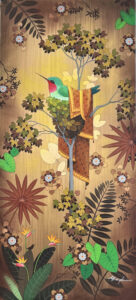
This is primarily a skill-based decision. How can I minimise or maximise something to scale? For instance, if I draw a moth, I could either look at the moth in its entirety, or I could focus on the many interesting patterns in the wings of a moth and highlight only that. I always try to find a balance between the two because, for me, there has to be a certain message to every painting.
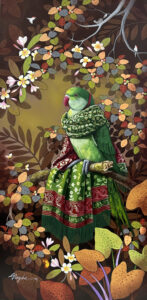
You mention how you felt the need to honour the creatures like a chameleon with a shawl or a monkey with a shawl – creatures that work invisibly in the forest. Why is there a need to make something visible?
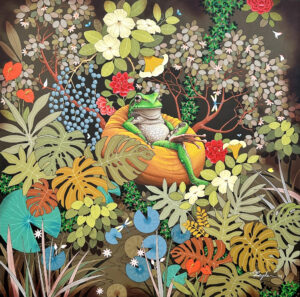
I think this is also part of my creative, visual language, my signature style of how to make an idea more impactful and meaningful. For example, the shawl is quite a common way of honouring someone in the village. This concept of wrapping the shawl around any creature – male or female, it does not matter – brings a human touch to it. Around 10 years ago, I did another series with frogs, one with a laptop and one with a mobile phone. At that time, the iPhone 4 was introduced in the market and everyone was going crazy with that phone. I did a small painting titled ‘Look at Me’ where the frog is staring into an iPhone 4. Another one was of the frog having an online meeting. These were all from my personal experience, and at that time, no one gave these paintings much attention, no one bought them. Then COVID happened, and suddenly, people started connecting with these paintings, and everything was sold out. So we never really know. Art is a miracle, somewhere something happens, and something becomes visible again.
Do you find the spiritual lives in nature or do you think nature allows us humans to see and feel the spiritual better?
I think it is the second one. I feel being with nature, understanding life in nature, really helps us think in a larger way, not in a narrow, mean-minded way. Nature makes us more spiritual. Just sitting in a calm space in nature, or even just imagining this space, makes one feel better. In traditional miniature paintings, you will see this correlation, of the real and the imagined. Long back, a tour guide in Rajasthan was showing us a sequential painting of a bear hunting in a forest. It was a large painting from the 11th century by an unknown artist. The guide asked us how many bears were hunting in the painting and everyone said 8 or 9, but I said there was only one. The painting was signifying the many modes of hunting. It reminded me of a painting I did when I was in the eighth standard about a boy crossing a river during a storm, for which I won the children’s international award. What I mean to say is nature is all encompassing and we are a lot more connected to that spiritual aspect than we think or imagine.
You often talk about correlating nature with other things – a banana leaf as a stomach, a hibiscus as a Ganesha’s face – what is it about nature that you think allows us to imagine and interpret as we wish?
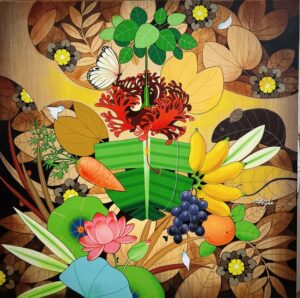
Whenever I go to my hometown during the festival of Ganesh Chathurthi, there is a practice in the village of a puja called Pallavelli. It is a kind of square frame or roof above the idol of ganesha made entirely of fruits and vegetables. It is square shaped, and every knot of the thread tied across the frame will have a fruit or a vegetable. Just before the idol is immersed, we would pluck them out to eat it. These experiences live deeply in my being. When you start working on a painting, then unknowingly all of this comes out. We have to unlearn to learn something in this journey of art. We haven’t seen god, but we have seen nature and the truth is that the leaves, the earth and the mud are gods, we cannot live without them. Every god is connected to nature, and every god has its own flower or fruit or animal. I wanted to showcase that connection. For example, this particular hibiscus called ‘jhumka hibiscus’ or Japanese hibiscus is an upside-down flower. It grows everywhere in coastal Karnataka and requires no maintenance. It struck me that when looked in a certain angle, it is shaped like a Ganesha. Everyone has drawn a Ganesha in their own style, but for me, I saw this in nature.
The banana leaf also we use in all our rituals, but to bring that as the main metaphor is a kind of evolution. I could have explored that metaphor in multiple ways, as a collage, a mural or sculpture, but somewhere you have to stop and get into yourself. You reach a point where you have to leave certain things to be able to go ahead. Sometimes, when I look at my earlier work, I can see that I have evolved. Sometimes I will work for too long on a painting, sometimes I have to set it aside and pick it up again later… this is the process, it is a natural thing.
Nature is a constantly a work in progress – do you see your own practice as this reflection of nature? A constant work in progress?
True, yes, this is part and parcel of being an artist. What we see and how we perceive it, and how we respond to things around us, all of this matters a lot. Nowadays, you can see so much madness in Bangalore, in the world even, but the main part is to keep going. In Kannada, we have a saying, that if a fly falls into a bowl of rice flour kanji, it can neither fly nor die, it will be somewhere in between, struggling but living. So we have to keep going.
Finally, how do you think this visual language of yours will evolve over time? What speaks to you more – colour or the form?
Both the ways, colour and form, and thought-wise, too – that real thought has to be there, which is neither negative nor positive, but stays in the middle.
Share